


Search intent analysis is the process of figuring out what a person actually wants to accomplish when they search a keyword, then matching that intent with the right content, page type, format, funnel stage, and conversion path.
A keyword alone doesn't tell you everything.
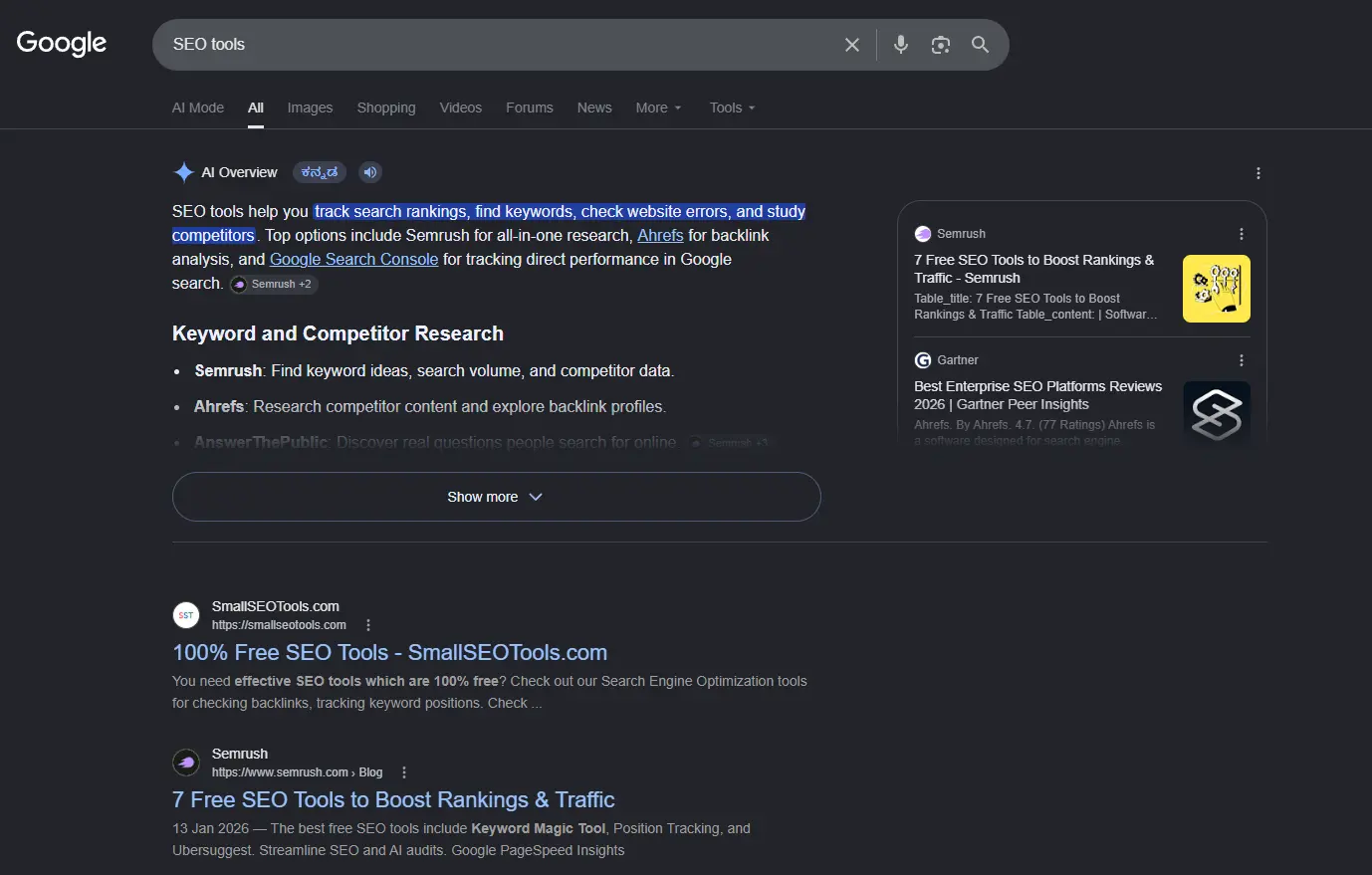
For example, in the image above, someone searching for “SEO tools” could be looking for free tools they can use immediately, or they might be looking for paid tools, a comparison of different options, pricing information, or user reviews. The query is short, but the searcher's underlying goals can be very different.
I learned this the hard way on some SEO projects. I’ve had pages that looked well-optimized and targeted a keyword with decent search volume, yet they simply wouldn’t move. When I looked more closely at the SERP, the problem became obvious: we were giving searchers the kind of content we wanted to rank with, not the kind of content Google had learned they actually wanted.
That's why effective SEO goes beyond keyword research.
You need to understand the job behind the search.
Google's search results provide one of the strongest clues. The pages, formats, SERP features, and content angles Google already ranks can reveal what users expect to see. Search tools such as Semrush and Ahrefs also classify intent, but their labels should be treated as a starting point rather than the final answer.
Search intent analysis becomes even more important as search moves toward AI-generated answers. Users are asking longer questions, combining several needs into one prompt, and looking for recommendations, solutions, comparisons, and actions rather than simple information. Google says its AI search experiences still rely on the same basic principle: create unique, useful content that satisfies people's needs.
This guide shows you how to analyze intent, score it, map it to content, detect mismatches, avoid cannibalization, and adapt your strategy for SEO, AEO, GEO, local search, e-commerce, and AI search.
Search Intent Analysis vs Search Intent
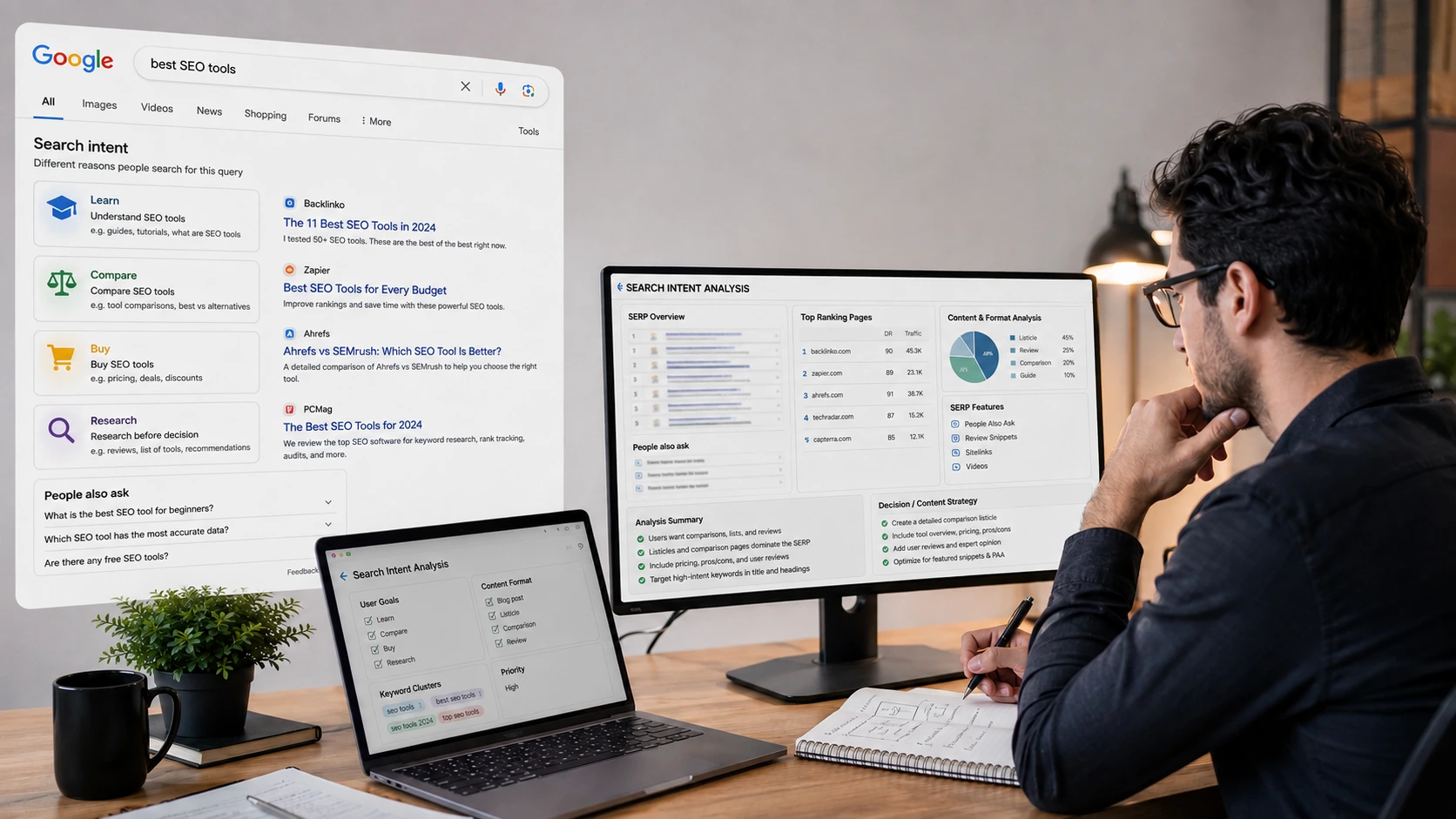
Search intent is the reason behind a search.
Search intent analysis is the process you use to identify that reason and turn it into an SEO decision.
If you want to understand the fundamentals of search intent, including the four main types, why intent matters, and how Google interprets it, see our complete SEO guide
| Concept | Meaning |
| Search intent | What the searcher wants |
| Search intent analysis | How you determine what they want |
| Intent mapping | How you connect intent to a page or content asset |
| Intent matching | How you make your page satisfy that intent |
Search intent is the destination.
Search intent analysis is the route you take to get there.
The four familiar intent categories, informational, navigational, commercial, and transactional, are useful starting points. But real SERPs are often more complicated. A single keyword can contain multiple intents, and the dominant intent can change over time.
That distinction is the foundation of this entire process.
Why Search Intent Analysis Matters in SEO
Ranking for the Right Keyword Isn't Enough
A keyword can have excellent search volume and still be a poor target.
Suppose you sell SEO consulting services and find the keyword:
“SEO”
It has enormous potential traffic.
But what does the searcher want?
A definition?
A beginner's guide?
An SEO course?
An SEO agency?
A tool?
A checklist?
A job?
The keyword is too broad to tell you.
The SERP gives you more useful information.
Your goal isn't simply to rank for the words. It's to create the page that best fits what people expect after entering those words.
Google's own guidance focuses on helpful, reliable, people-first content that satisfies the visitor's goal rather than content created primarily to manipulate rankings.
Traffic Can Have the Wrong Intent
Not all organic traffic has the same value.
Imagine two keywords:
- “what is SEO”
- “hire SEO consultant”
The first may attract thousands of informational searches.
The second may attract far fewer searches but much stronger commercial intent.
If your business sells SEO services, ranking for the second query may be more valuable.
This is why traffic should be evaluated alongside:
- Intent
- Funnel stage
- Business relevance
- Conversion potential
- Page type
- Audience fit
Search volume tells you how many people may search.
Intent helps you understand why they search.
Intent Determines the Right Page Type
Search intent often determines what kind of page should rank.
For example:
| Query | Likely intent | Suitable page |
| what is SEO | Informational | Guide |
| SEO checklist | Informational | Checklist/article |
| best SEO tools | Commercial | Comparison/list |
| Semrush pricing | Commercial/Transactional | Pricing page |
| hire SEO consultant | Transactional | Service page |
| SEO agency Bangalore | Local commercial | Local service page |
| Ahrefs login | Navigational | Login page |
Creating a blog post for every keyword isn't a strategy.
Sometimes the correct answer is a service page.
Sometimes it's a category page.
Sometimes it's a product page.
Sometimes it's a comparison.
Sometimes it's a location page.
Intent Influences Business Value
A useful SEO strategy connects search intent with business outcomes.
A simple model is:
Keyword → Intent → Funnel stage → Page → CTA → Business outcome
For example:
“how to improve Google rankings”
→ Informational intent
→ Awareness
→ Educational guide
→ Related SEO checklist
→ Lead nurturing
Compare that with:
“SEO consultant for small business”
→ Commercial/transactional intent
→ Decision stage
→ Service landing page
→ Consultation CTA
→ Lead
The second query may have less traffic but greater commercial value.
The Search Intent Analysis Framework
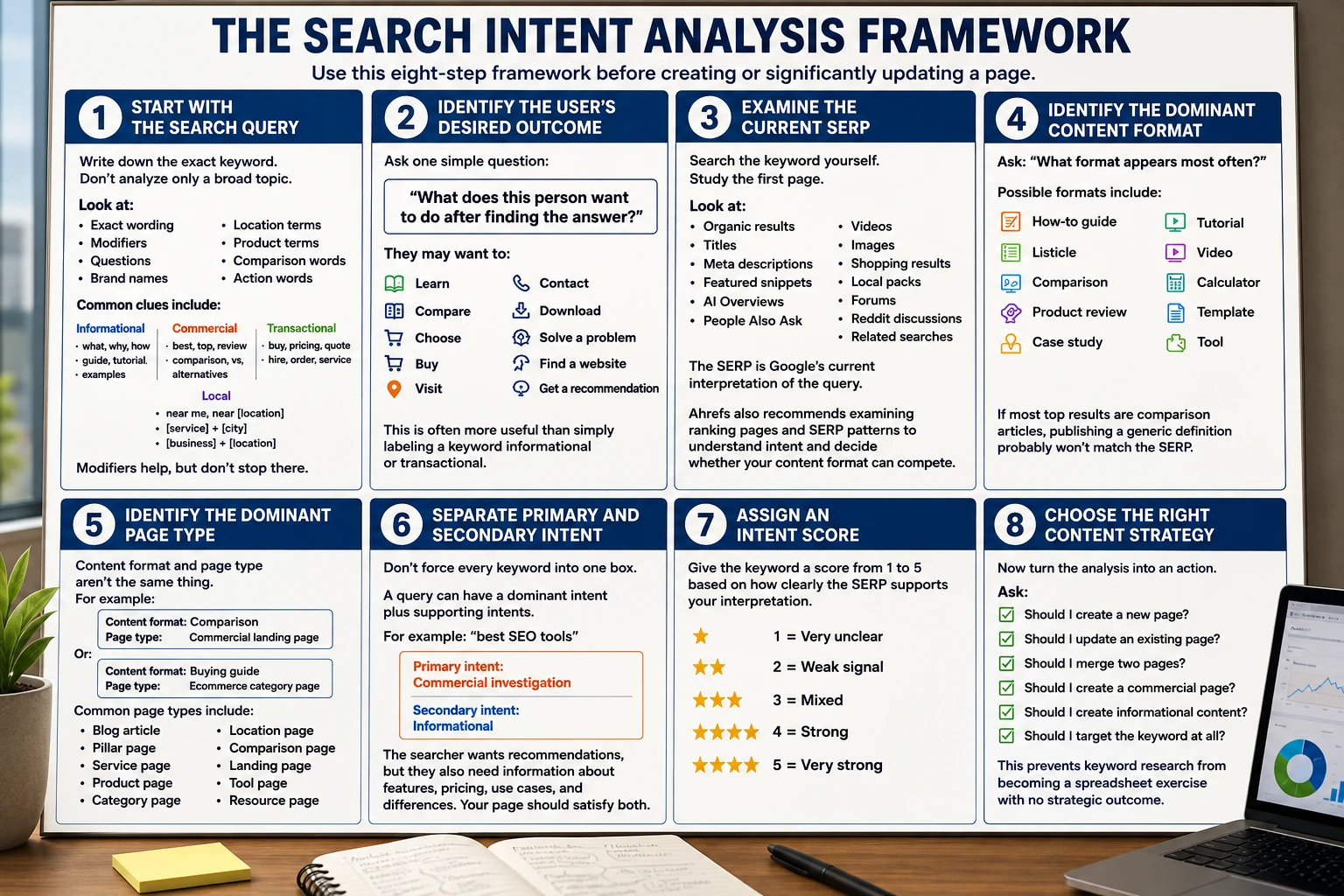
Use this eight-step framework before creating or significantly updating a page.
Step 1: Start With the Search Query
Write down the exact keyword.
Don't analyze only a broad topic.
Look at:
- Exact wording
- Modifiers
- Questions
- Brand names
- Location terms
- Product terms
- Comparison words
- Action words
Common clues include:
Informational
- what
- why
- how
- guide
- tutorial
- examples
Commercial
- best
- top
- review
- comparison
- vs
- alternatives
Transactional
- buy
- pricing
- quote
- hire
- order
- service
Local
- near me
- near [location]
- [service] + [city]
- [business] + [location]
Modifiers help, but don't stop there.
Step 2: Identify the User's Desired Outcome
Ask one simple question:
“What does this person want to do after finding the answer?”
They may want to:
- Learn
- Compare
- Choose
- Buy
- Visit
- Contact
- Download
- Solve a problem
- Find a specific website
- Get a recommendation
This is often more useful than simply labeling a keyword informational or transactional.
Step 3: Examine the Current SERP
Search the keyword yourself.
Study the first page.
Look at:
- Organic results
- Titles
- Meta descriptions
- Featured snippets
- AI Overviews
- People Also Ask
- Videos
- Images
- Shopping results
- Local packs
- Forums
- Reddit discussions
- Related searches
The SERP is Google's current interpretation of the query.
Ahrefs also recommends examining ranking pages and SERP patterns to understand intent and decide whether your content format can compete.
Step 4: Identify the Dominant Content Format
Ask:
“What format appears most often?”
Possible formats include:
- How-to guide
- Listicle
- Comparison
- Product review
- Case study
- Tutorial
- Video
- Calculator
- Template
- Tool
- Category page
- Product page
- Service page
If most top results are comparison articles, publishing a generic definition probably won't match the SERP.
Step 5: Identify the Dominant Page Type
Content format and page type aren't the same thing.
For example:
Content format: comparison
Page type: commercial landing page
Or:
Content format: buying guide
Page type: ecommerce category page
Common page types include:
- Blog article
- Pillar page
- Service page
- Product page
- Category page
- Location page
- Comparison page
- Landing page
- Tool page
- Resource page
Step 6: Separate Primary and Secondary Intent
Don't force every keyword into one box.
A query can have a dominant intent plus supporting intents.
For example:
“best SEO tools”
Primary intent:
Commercial investigation
Secondary intent:
Informational
The searcher wants recommendations, but they also need information about features, pricing, use cases, and differences.
Your page should satisfy both.
Step 7: Assign an Intent Score
Give the keyword a score from 1 to 5 based on how clearly the SERP supports your interpretation.
A score of:
1 = Very unclear
2 = Weak signal
3 = Mixed
4 = Strong
5 = Very strong
We'll build a complete scoring model below.
Step 8: Choose the Right Content Strategy
Now turn the analysis into an action.
Ask:
- Should I create a new page?
- Should I update an existing page?
- Should I merge two pages?
- Should I create a commercial page?
- Should I create informational content?
- Should I target the keyword at all?
This prevents keyword research from becoming a spreadsheet exercise with no strategic outcome.
How to Score Search Intent
The scoring model below is useful when you're building keyword maps, content briefs, or large SEO campaigns.
Primary Intent
Primary intent represents the main job the searcher wants completed.
Examples:
- Learn how SEO works
- Compare SEO tools
- Buy an SEO tool
- Find an SEO agency
- Visit a local business
Your primary intent should determine the core purpose of the page.
Secondary Intent
Secondary intent represents additional needs that support the primary goal.
For “best SEO tools for small business”:
Primary:
Compare tools
Secondary:
- Understand features
- Compare pricing
- Find beginner-friendly options
- Identify suitable tools
- Understand limitations
These secondary needs can shape your headings, tables, FAQs, examples, and CTAs.
Intent Confidence Score
Intent confidence measures how certain you are about your interpretation.
Consider five signals:
- Top-ranking page consistency
- Content format consistency
- Page type consistency
- SERP feature consistency
- User wording
The more signals agree, the higher your confidence.
A Simple 1-to-5 Intent Scoring Model
Use this model:
| Score | Meaning | Action |
| 1 | Very unclear | Investigate further |
| 2 | Weak pattern | Don't commit yet |
| 3 | Mixed SERP | Build for multiple intents |
| 4 | Strong pattern | Follow dominant SERP |
| 5 | Very clear | Match SERP closely |
You can also calculate a simple score:
Intent Confidence = Matching SERP signals ÷ Total signals × 5
For example:
- 8 of 10 ranking pages are guides
- 8 of 10 are informational
- PAA questions are educational
- No strong shopping results
Your confidence is high.
The exact formula isn't a Google ranking factor. It's a decision-making framework for your SEO workflow.
That's what makes it useful.
How to Analyze a SERP for Search Intent
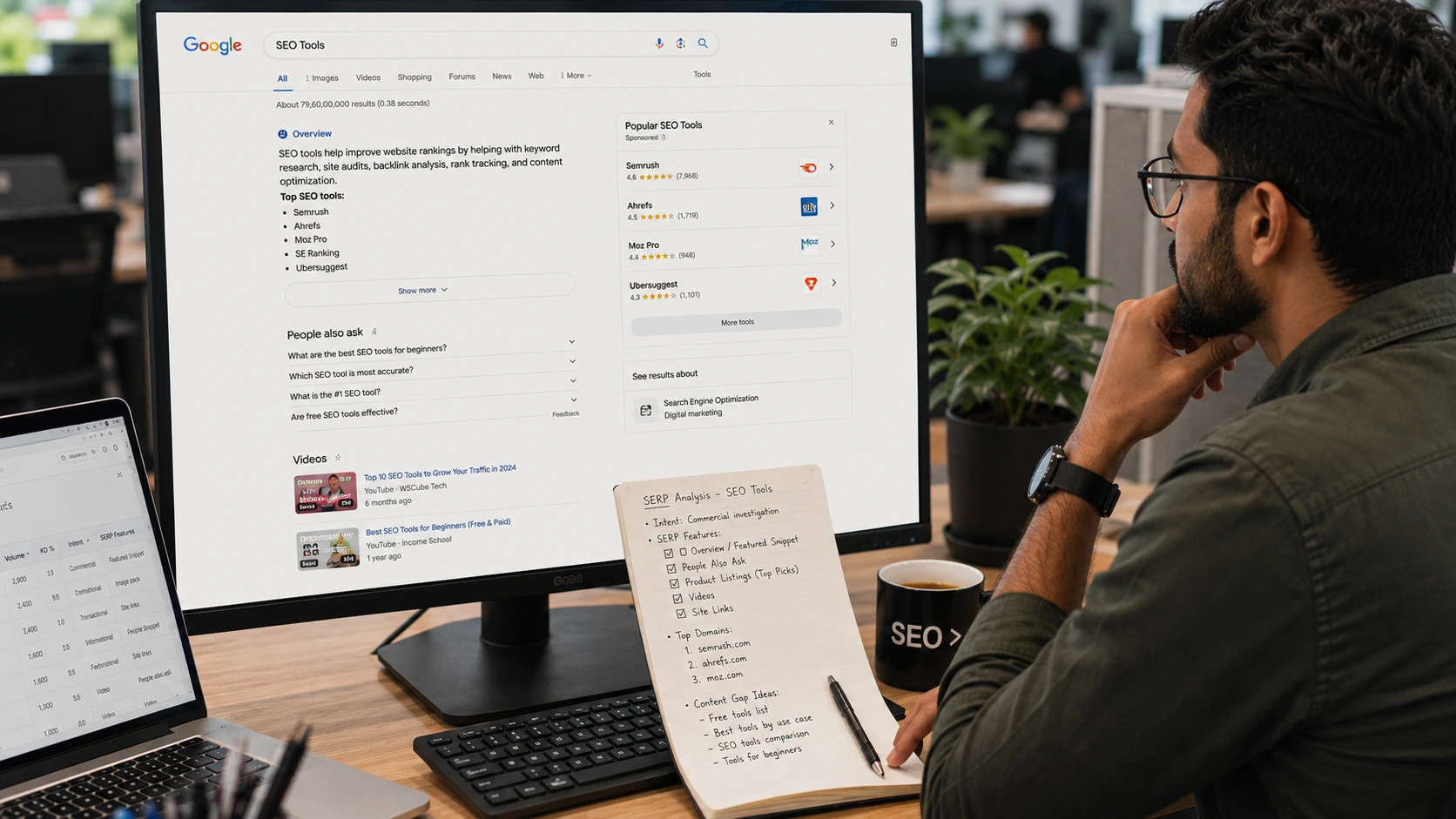
Look at the Top-Ranking Pages
Don't study only position one.
Analyze at least the top 10 results.
Look for patterns.
Record:
- URL
- Title
- Page type
- Content format
- Content depth
- Freshness
- Brand strength
- Unique features
- Search angle
Ahrefs' SERP tools now include intent identification and historical SERP comparison, which can help SEOs examine how intent patterns change over time.
Compare Content Formats
Count the formats.
Example:
- 6 comparison articles
- 2 review pages
- 1 video
- 1 category page
The dominant format is comparison content.
That's a strong signal.
Compare Page Types
Now classify the URLs.
For example:
- 7 blog posts
- 2 product pages
- 1 category page
Your opportunity is probably editorial content rather than a product page.
But don't copy the SERP blindly.
Look for gaps.
Analyze SERP Features
SERP features can reveal what Google believes users need.
Look for:
- AI Overviews
- Featured snippets
- PAA
- Local Pack
- Image results
- Video results
- Shopping results
- Reviews
- Knowledge panels
- Site links
- Discussions and forums
For AEO, question-based SERP features are particularly useful because they reveal the questions users ask around the main topic.
Check PAA and Related Searches
People Also Ask can reveal secondary intent.
For example, a keyword about SEO tools might produce questions such as:
- What is the best free SEO tool?
- Which SEO tool is best for beginners?
- Is Semrush better than Ahrefs?
- Are SEO tools worth it?
These questions can become supporting sections.
Related searches can reveal adjacent needs and query variations.
Look for Forum and Reddit Results
Forums can reveal language that traditional keyword tools miss.
Pay attention to:
- Problems
- Complaints
- Objections
- Questions
- Comparisons
- Personal experiences
- Product frustrations
This is useful for both SEO and GEO.
AI systems often need clear, useful answers to real-world questions. User discussions can help you understand the underlying problem rather than just the keyword.
Identify Freshness Signals
Some topics change quickly.
Examples:
- SEO
- AI tools
- Software
- Prices
- Regulations
- Technology
- Product specifications
Other topics are relatively stable.
If ranking pages are frequently updated, that's a signal that freshness may matter.
Don't change the date just to make an old article look new. Google specifically warns against changing dates when the content hasn't substantially changed.
Determine the Dominant SERP Pattern
At the end of your SERP analysis, complete this sentence:
“Most searchers appear to want ______.”
Then complete:
“Google mainly serves this need with ______.”
For example:
Most searchers want to compare SEO tools for their business.
Google mainly serves this need with comparison articles, tool lists, reviews, and commercial pages.
That's your SERP intent pattern.
How to Handle Mixed Search Intent
What Is Mixed Intent?
Mixed intent happens when one query can reasonably represent several user goals.
For example:
“SEO tools”
could mean:
- What are SEO tools?
- Which SEO tools exist?
- Which tool is best?
- Which tool should I buy?
- Where can I access an SEO tool?
The SERP may contain several formats.
Mixed intent isn't a problem.
It simply requires a more flexible content strategy.
Primary vs Secondary Intent
Don't give every intent equal weight.
Choose one primary goal.
Then support it with secondary goals.
For example:
Keyword: best SEO tools
Primary: Commercial investigation
Secondary: Informational
Your page should primarily help users compare options.
It shouldn't become a 4,000-word beginner course about SEO.
When One Page Can Satisfy Multiple Intents
One page can serve multiple intents when the intents are closely related.
For example:
“best SEO tools for small business”
One page could include:
- What SEO tools do
- Best tools
- Feature comparison
- Pricing
- Pros and cons
- Use cases
- Recommendations
- FAQs
That's a good multi-intent page.
When Separate Pages Are Better
Create separate pages when the intents require different experiences.
For example:
“SEO audit checklist”
and
“SEO audit service”
These are related but different.
The first needs educational content.
The second needs a service page with:
- Benefits
- Process
- Proof
- Pricing or quote
- FAQs
- CTA
Trying to make one page satisfy both can weaken both experiences.
Examples of Mixed-Intent Keywords
| Keyword | Primary intent | Secondary intent |
| best SEO tools | Commercial | Informational |
| SEO audit | Informational/Commercial | Transactional |
| SEO agency | Commercial | Local |
| WordPress SEO | Informational | Commercial |
| SEO consultant Bangalore | Commercial | Local/Transactional |
| SEO software | Commercial | Transactional |
| SEO pricing | Commercial | Transactional |
Mixed intent should influence your page structure, not confuse it.
Search Intent Mapping for SEO Content
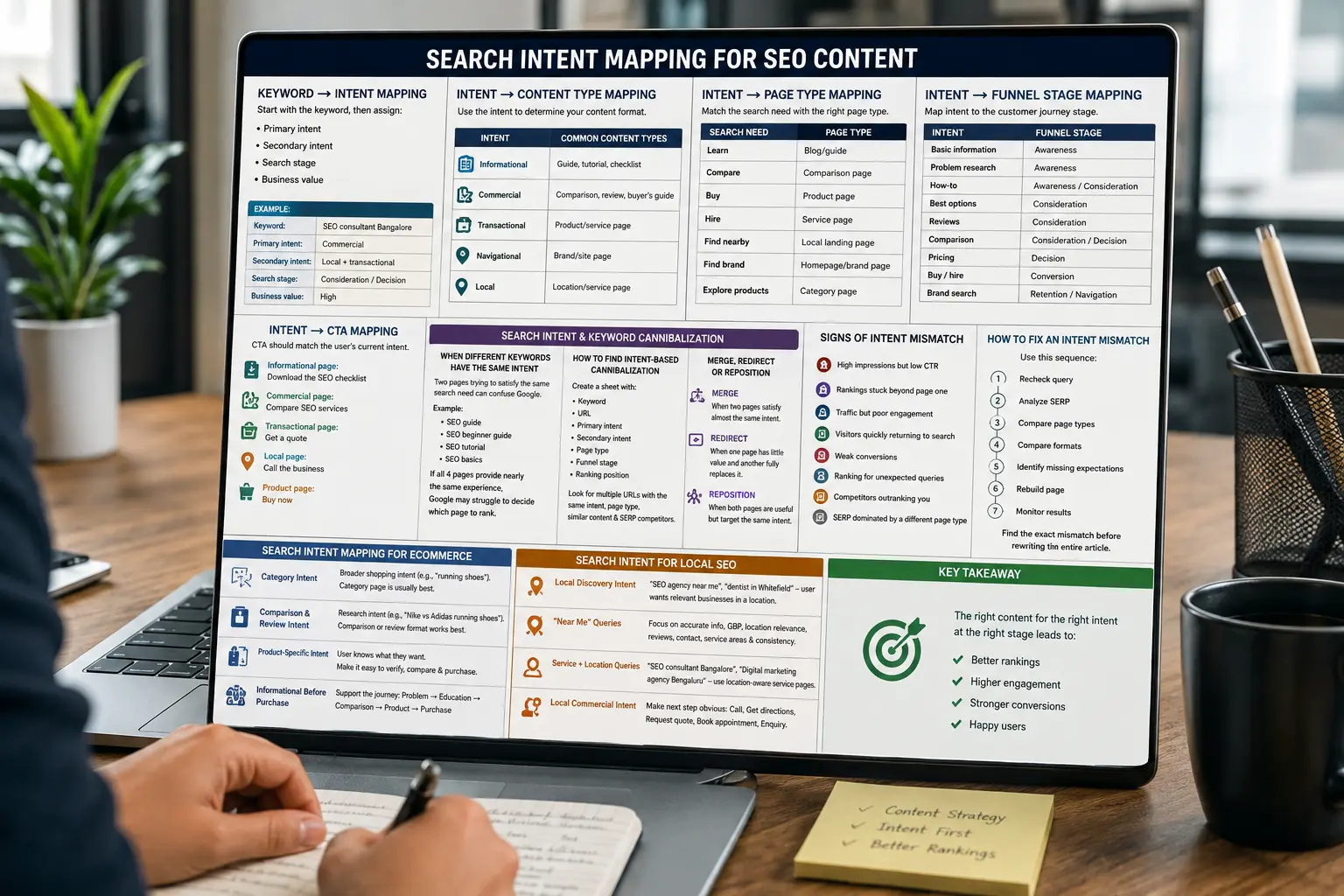
This is where search intent analysis becomes a real content strategy.
Keyword → Intent Mapping
Start with the keyword.
Then assign:
- Primary intent
- Secondary intent
- Search stage
- Business value
Example:
Keyword: SEO consultant Bangalore
Primary intent: Commercial
Secondary intent: Local + transactional
Intent → Content Type Mapping
Use the intent to determine your content format.
| Intent | Common content types |
| Informational | Guide, tutorial, checklist |
| Commercial | Comparison, review, buyer's guide |
| Transactional | Product/service page |
| Navigational | Brand/site page |
| Local | Location/service page |
These aren't rigid rules.
The SERP always gets the final vote.
Intent → Page Type Mapping
| Search need | Page type |
| Learn | Blog/guide |
| Compare | Comparison page |
| Buy | Product page |
| Hire | Service page |
| Find nearby | Local landing page |
| Find brand | Homepage/brand page |
| Explore products | Category page |
Intent → Funnel Stage Mapping
Intent can also map to the customer journey.
| Intent | Funnel stage |
| Basic information | Awareness |
| Problem research | Awareness |
| How-to | Awareness/Consideration |
| Best options | Consideration |
| Reviews | Consideration |
| Comparison | Consideration/Decision |
| Pricing | Decision |
| Buy/hire | Conversion |
| Brand search | Retention/Navigation |
This helps you build a balanced content funnel.
Intent → CTA Mapping
Don't use the same CTA everywhere.
Informational page:
Download the SEO checklist
Commercial page:
Compare SEO services
Transactional page:
Get a quote
Local page:
Call the business
Product page:
Buy now
The CTA should match the user's current intent.
Search Intent and Keyword Cannibalization
When Different Keywords Have the Same Intent
Keyword cannibalization isn't simply about two pages ranking for similar words.
A bigger issue is two pages trying to satisfy the same search need.
For example:
- SEO guide
- SEO beginner guide
- SEO tutorial
- SEO basics
If all four pages provide nearly the same experience, Google may struggle to determine which page deserves visibility.
How to Find Intent-Based Cannibalization
Create a sheet containing:
- Keyword
- URL
- Primary intent
- Secondary intent
- Page type
- Funnel stage
- Ranking position
Then look for multiple URLs with:
- Same primary intent
- Same page type
- Similar content
- Similar target audience
- Similar SERP competitors
That's an intent-based cannibalization risk.
Blog vs Service Page Cannibalization
This is common.
Suppose you have:
/blog/seo-services/
and
/seo-services/
If both pages target:
“SEO services”
you've created a strategic conflict.
The service page should target commercial/transactional intent.
The blog article could target:
“what are SEO services”
or
“how SEO services work.”
Different intent creates clearer page roles.
When to Merge, Redirect, or Reposition Pages
Merge when two pages satisfy almost the same intent.
Redirect when one page has little independent value and another page fully replaces it.
Reposition when both pages are useful but currently target the same intent.
For example:
Page A:
SEO guide for beginners
Page B:
Technical SEO guide
Both can exist because their intents and scope differ.
How to Detect Search Intent Mismatch
Signs Your Page Targets the Wrong Intent
Common signals include:
- High impressions but low CTR
- Rankings stuck beyond page one
- Traffic but poor engagement
- Visitors quickly returning to search
- Weak conversions
- Ranking for unexpected queries
- Competitors consistently outranking you
- SERP dominated by a different page type
One signal alone doesn't prove an intent mismatch.
Look for patterns.
Wrong Content Format
Suppose Google ranks:
- Comparisons
- Reviews
- Product lists
But your page is a definition article.
The format may be wrong.
Change the format.
Wrong Page Type
If Google mostly ranks service pages and you have a blog post, you may need a service landing page.
If Google ranks product pages, a generic article may struggle.
Wrong Depth
Sometimes the format is correct but the content doesn't go far enough.
For a commercial comparison, users may expect:
- Pricing
- Features
- Pros and cons
- Alternatives
- Use cases
- Recommendations
A shallow list may not satisfy that intent.
Wrong Conversion Path
Your content may answer the question but lead nowhere.
For example:
A commercial keyword lands on a blog article with no relevant next step.
Add a logical CTA.
Don't force a sales pitch.
Help the reader take the next step.
How to Fix an Intent Mismatch
Use this sequence:
Recheck query → Analyze SERP → Compare page types → Compare formats → Identify missing expectations → Rebuild page → Monitor results
Don't immediately rewrite the entire article.
First identify the exact mismatch.
Search Intent Mapping for Ecommerce
Category vs Product Intent
A category query often represents broader shopping intent.
Example:
“running shoes”
A category page can satisfy this.
A product query is more specific:
“Nike Air Zoom Pegasus 42”
A product page is usually more appropriate.
Comparison and Review Intent
Queries such as:
- Nike vs Adidas running shoes
- Best running shoes for beginners
- Nike Pegasus review
suggest research.
A comparison or review format is often a better fit than a generic product page.
Product-Specific Intent
When the query includes a specific product, model, SKU, or brand, the user may already know what they want.
The page should make it easy to:
- Verify specifications
- Check availability
- Review price
- Compare variants
- Understand shipping
- Purchase
Informational Queries Before Purchase
Ecommerce customers often research before buying.
Examples:
- How to choose running shoes
- How should running shoes fit?
- Best running shoes for flat feet
These searches can support the product journey without turning every article into a sales page.
A useful ecommerce content path is:
Problem → Education → Comparison → Product → Purchase
Search Intent for Local SEO
Local search adds another layer to intent.
The user isn't only asking what.
They're often asking:
“Where can I get this?”
Local Discovery Intent
Examples:
- SEO agency near me
- Digital marketing agency Bangalore
- dentist in Whitefield
- best restaurants near me
The user wants businesses relevant to a geographic area.
“Near Me” Queries
“Near me” doesn't necessarily mean the page needs the exact phrase repeated throughout the content.
Google can use location signals to understand geographic relevance.
Focus on:
- Accurate business information
- Google Business Profile
- Location relevance
- Local landing pages
- Reviews
- Contact details
- Service areas
- Local references
- Consistent business information
Service + Location Queries
Examples:
SEO consultant Bangalore
Digital marketing agency Bangalore
SEO services in Bengaluru
These can have commercial local intent.
The right page is usually a location-aware service page, not a generic blog post.
Local Commercial Intent
A local commercial searcher may be close to taking action.
Your page should make the next step obvious:
- Call
- Get directions
- Request quote
- Book appointment
- Visit website
- Send enquiry
Local SEO should connect geographic relevance with business intent.
Search Intent in AI Search and AI Overviews
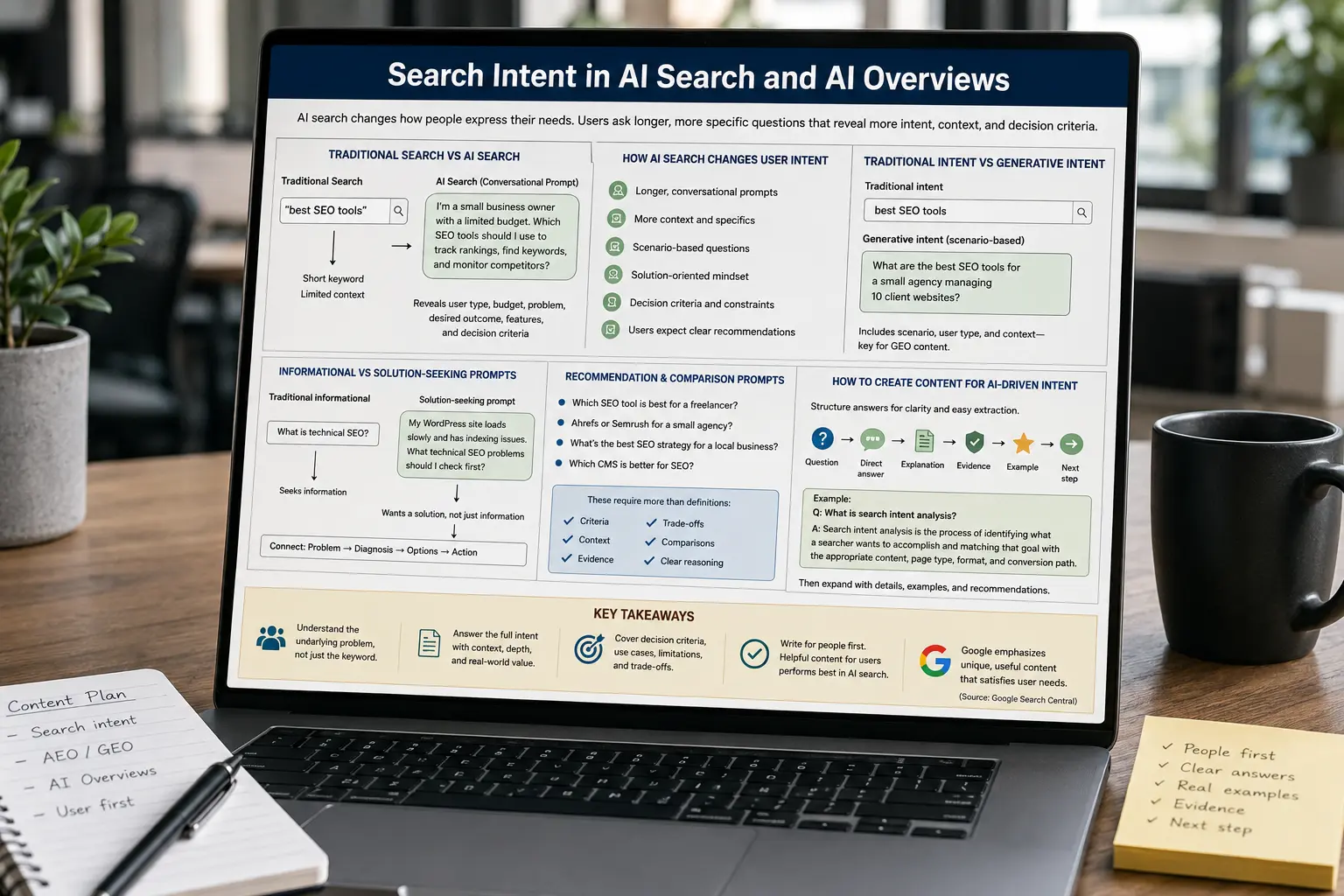
AI search changes how people express their needs.
Traditional search often looks like:
“best SEO tools”
An AI prompt may look like:
“I'm a small business owner with a limited budget. Which SEO tools should I use to track rankings, find keywords, and monitor competitors?”
The second prompt contains far more intent.
It reveals:
- User type
- Budget
- Problem
- Desired outcome
- Features
- Decision criteria
Google says users are asking longer and more specific questions in its AI search experiences, while still emphasizing unique, useful content that satisfies user needs.
How AI Search Changes User Intent
Traditional keyword research focuses heavily on short queries.
AI search creates longer, conversational prompts.
Users may ask:
- What should I choose?
- Which option is best for my situation?
- Compare these three products.
- Give me a step-by-step plan.
- What would you recommend?
- What are the risks?
- Which service is best for a small business?
Your content needs to answer the underlying problem, not just repeat the keyword.
Traditional Search Intent vs Generative Search Intent
Traditional intent:
“best SEO tools”
Generative intent:
“What are the best SEO tools for a small agency managing 10 client websites?”
The second query contains a scenario.
That scenario matters.
For GEO, create content that covers:
- Clear definitions
- Direct answers
- Decision criteria
- Comparisons
- Use cases
- Limitations
- Examples
- Evidence
- Expert reasoning
- Specific recommendations
Informational Queries vs Solution-Seeking Prompts
Traditional informational:
“What is technical SEO?”
Solution-seeking prompt:
“My WordPress site loads slowly and has indexing issues. What technical SEO problems should I check first?”
The second user doesn't only want information.
They want a solution.
Your content should connect:
Problem → Diagnosis → Options → Action
Recommendation and Comparison Prompts
AI search is well suited to recommendation-style questions.
Examples:
- Which SEO tool is best for a freelancer?
- Ahrefs or Semrush for a small agency?
- What's the best SEO strategy for a local business?
- Which CMS is better for SEO?
These require more than definitions.
They require:
- Criteria
- Trade-offs
- Context
- Comparisons
- Evidence
- Clear reasoning
How to Create Content for AI-Driven Intent
For AEO and GEO, structure important answers so they're easy to understand and extract.
Use:
Question → Direct answer → Explanation → Evidence → Example → Next step
For example:
What is search intent analysis?
Search intent analysis is the process of identifying what a searcher wants to accomplish and matching that goal with the appropriate content, page type, format, and conversion path.
Then expand.
This structure helps both humans and machines understand the answer.
Seer has also highlighted the shift from traditional search behavior toward conversational prompts and solution-oriented AI interactions.
The key point isn't to write for AI instead of people.
Write useful content that works for people first.
That is also consistent with Google's guidance for AI search.
How to Analyze Search Intent Using SEO Tools
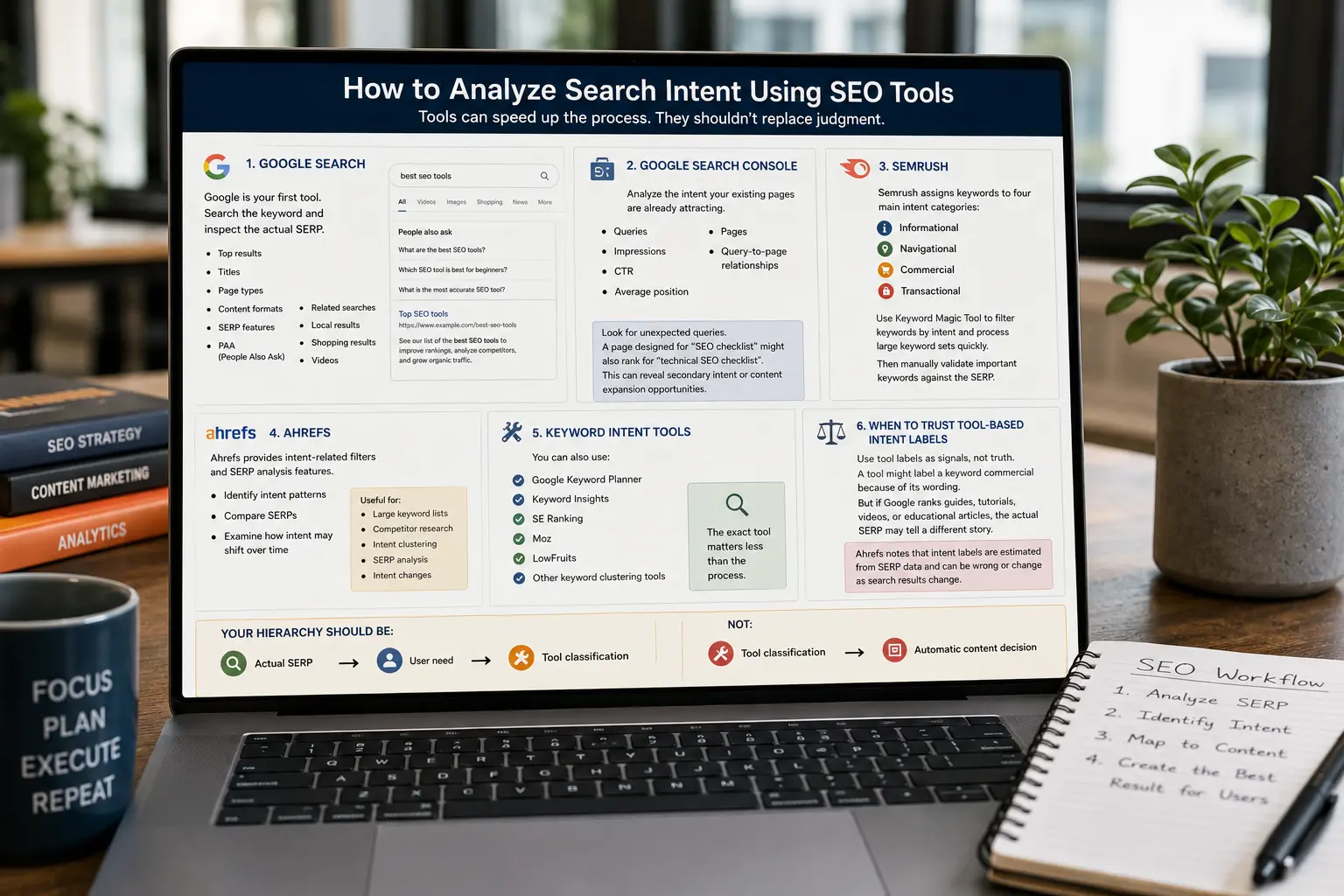
Tools can speed up the process.
They shouldn't replace judgment.
Google Search
Google is your first tool.
Search the keyword and inspect the actual SERP.
Check:
- Top results
- Titles
- Page types
- Content formats
- SERP features
- PAA
- Related searches
- Local results
- Shopping results
- Videos
This is the closest practical view of what Google currently believes users want.
Google Search Console
Search Console helps you analyze the intent your existing pages are already attracting.
Look at:
- Queries
- Impressions
- CTR
- Average position
- Pages
- Query-to-page relationships
Look for unexpected queries.
A page designed for “SEO checklist” might also rank for:
“technical SEO checklist”
That can reveal secondary intent or content expansion opportunities.
Semrush
Semrush assigns keywords to four main intent categories:
- Informational
- Navigational
- Commercial
- Transactional
Its Keyword Magic Tool also lets you filter keywords by intent.
Use this to process large keyword sets quickly.
Then manually validate important keywords against the SERP.
Ahrefs
Ahrefs provides intent-related filters and SERP analysis features.
Its current tools can identify intent patterns, compare SERPs, and examine how intent may shift over time.
This is particularly useful for:
- Large keyword lists
- Competitor research
- Intent clustering
- SERP analysis
- Intent changes
Keyword Intent Tools
You can also use:
- Keyword Planner
- Keyword Insights
- SE Ranking
- Moz
- LowFruits
- Other keyword clustering tools
The exact tool matters less than the process.
When to Trust Tool-Based Intent Labels
Use tool labels as signals, not truth.
A tool might label a keyword commercial because of its wording.
But if Google ranks:
- Guides
- Tutorials
- Videos
- Educational articles
the actual SERP may tell a different story.
Ahrefs itself notes that intent labels are estimated from SERP data and can be wrong or change as search results change.
Your hierarchy should be:
Actual SERP → User need → Tool classification
Not:
Tool classification → automatic content decision
Search Intent Analysis Example
Let's walk through the complete process.
Keyword: “best SEO tools”
Step 1: Query
best SEO tools
The modifier “best” suggests comparison or commercial investigation.
But we still need to verify the SERP.
Step 2: Desired Outcome
The searcher probably wants to:
- Discover SEO tools
- Compare options
- Understand features
- Find the right tool
- Potentially choose a tool
Step 3: SERP
Assume the SERP is dominated by:
- Best SEO tool lists
- Tool comparisons
- Reviews
- Software roundups
- Commercial pages
That gives us a strong commercial-investigation signal.
Step 4: Content Format
Dominant format:
List/comparison article
Supporting formats:
- Reviews
- Product comparisons
- Feature tables
Step 5: Page Type
Recommended page:
Commercial editorial comparison
Not:
- Basic SEO definition
- Generic SEO guide
- Individual product page
Step 6: Primary Intent
Commercial investigation
Step 7: Secondary Intent
- Informational
- Feature research
- Pricing research
- Use-case matching
Step 8: Funnel Stage
Consideration
The searcher is evaluating options.
Step 9: Recommended Outline
A suitable outline could be:
H1: Best SEO Tools in 2026
H2: Quick Comparison of the Best SEO Tools
H2: Best SEO Tools at a Glance
H2: 1. [Tool]
H3: Best for
H3: Key features
H3: Pros and cons
H3: Pricing
H3: Who should use it?
H2: How to Choose an SEO Tool
H2: Best SEO Tools by Use Case
H3: Best for Keyword Research
H3: Best for Technical SEO
H3: Best for Local SEO
H3: Best for Agencies
H2: SEO Tool Comparison
H2: Frequently Asked Questions
This page satisfies the main commercial intent while supporting the informational questions around it.
Final Intent Map
Keyword: best SEO tools
Primary intent: Commercial
Secondary intent: Informational
SERP pattern: Comparison/list/review
Content format: List + comparison
Page type: Commercial editorial page
Funnel stage: Consideration
CTA: Start trial / Compare tools / View detailed review
Intent confidence: 5/5 if the SERP consistently supports this pattern
Search Intent Audit Template
Use this framework when auditing your existing content.
| Keyword | Primary Intent | Secondary Intent | SERP Type | Page Type | Funnel Stage | Current URL | Action |
| SEO guide | Informational | Commercial | Guides | Pillar page | Awareness | /seo-guide/ | Keep |
| best SEO tools | Commercial | Informational | Lists/comparisons | Comparison | Consideration | /seo-tools/ | Create |
| SEO consultant Bangalore | Commercial | Local/Transactional | Local/service | Service page | Decision | /seo-consultant-bangalore/ | Create |
| SEO pricing | Commercial | Transactional | Service/pricing | Landing page | Decision | /seo-pricing/ | Improve |
| technical SEO checklist | Informational | Transactional | Guides/checklists | Resource | Awareness | /technical-seo-checklist/ | Improve |
Add more columns if needed:
- Intent score
- Business value
- Search volume
- Conversion rate
- Current ranking
- Competitor URL
- Content gap
- Last reviewed date
This turns search intent analysis into an operational SEO process.
Common Search Intent Analysis Mistakes
Trusting Keyword Modifiers Alone
“Best” often signals commercial intent.
“Buy” often signals transactional intent.
“how to” often signals informational intent.
But these are clues.
Don't treat them as proof.
Ignoring the SERP
This is one of the biggest mistakes.
The keyword might look informational while the SERP is dominated by product pages.
Always validate.
Looking at Only One Ranking Page
One page can be an outlier.
Study the top results.
Look for the pattern.
Assuming Every Keyword Has One Intent
Some queries are clearly mixed.
Trying to force them into one category can produce weak content decisions.
Confusing Search Volume With Business Value
10,000 searches don't automatically beat 500 high-intent searches.
Ask:
“What happens if this user lands on my website?”
Using the Wrong Page Type
A blog post can't always compete with a service page.
A product page can't always compete with an informational guide.
Match the experience.
Never Rechecking Intent
Search intent can change.
New products appear.
SERPs evolve.
User behavior shifts.
AI search changes query patterns.
Ahrefs notes that intent can shift over time and provides historical SERP comparisons for identifying these changes.
Review important keywords regularly.
Search Intent Analysis Checklist
Use this before publishing or updating an important page.
- Record the exact target keyword
- Identify the user's desired outcome
- Assign a primary intent
- Identify secondary intent
- Search the keyword manually
- Review the top 10 results
- Compare page types
- Compare content formats
- Check SERP features
- Review PAA questions
- Review related searches
- Check forum and Reddit discussions
- Check freshness signals
- Identify the dominant SERP pattern
- Assign an intent confidence score
- Choose the correct page type
- Choose the correct content format
- Map the funnel stage
- Map the CTA
- Check for existing competing URLs
- Check for keyword cannibalization
- Create the content brief
- Recheck intent after publishing
- Update the page when the SERP meaning changes
Search Intent FAQs
How do I score search intent?
Use a 1-to-5 confidence score.
Score how strongly the SERP supports your interpretation.
1: Very unclear
2: Weak pattern
3: Mixed intent
4: Strong pattern
5: Very clear intent
Base the score on ranking-page consistency, content format, page type, SERP features, and query wording.
Can one keyword have multiple intents?
Yes.
Many keywords have mixed intent.
For example, “best SEO tools” has commercial intent because users are comparing options, but it also has an informational component because users need information before choosing.
Search tools also recognize that keywords can have more than one intent.
How do I know when search intent has changed?
Compare the current SERP with older SERPs.
Look for changes in:
- Ranking page types
- Content formats
- SERP features
- Search angles
- Freshness
- Commercial vs informational results
If the dominant pattern changes, your content strategy may need to change too.
Can search intent cause keyword cannibalization?
Yes.
When several pages target the same underlying search need, they may compete for the same SERP.
The solution isn't always deleting a page.
You may need to:
- Merge pages
- Redirect one page
- Change the target keyword
- Reposition the content
- Separate the search intent
How do I identify an intent mismatch?
Compare your page with the dominant SERP pattern.
Ask:
- Is my page type similar?
- Is my format similar?
- Does my content depth match?
- Does my page solve the same problem?
- Does my CTA fit the search stage?
If the answer is mostly no, you may have an intent mismatch.
How is search intent different in AI search?
AI search tends to make the user's underlying goal more explicit.
Instead of:
“best SEO tools”
a user might ask:
“Which SEO tools should a small agency use to manage keyword research, rankings, technical audits, and competitor research?”
The second prompt contains more context and decision criteria.
Your content should therefore cover the problem, context, options, trade-offs, and recommended actions.
Seer describes this broader shift as users moving from shorter keyword searches toward conversational prompts that reveal deeper goals and decision-making needs.
Should every keyword have a dedicated page?
No.
Multiple keywords can belong to the same page when they share the same underlying intent.
For example:
- search intent analysis
- search intent SEO
- analyze search intent
- search intent analysis process
could potentially be covered by one strong resource if the SERP and audience needs overlap.
Create a separate page when the search intent, audience, page type, or desired outcome is meaningfully different.
The Search Intent Workflow to Use in Your SEO Process
A practical workflow looks like this:
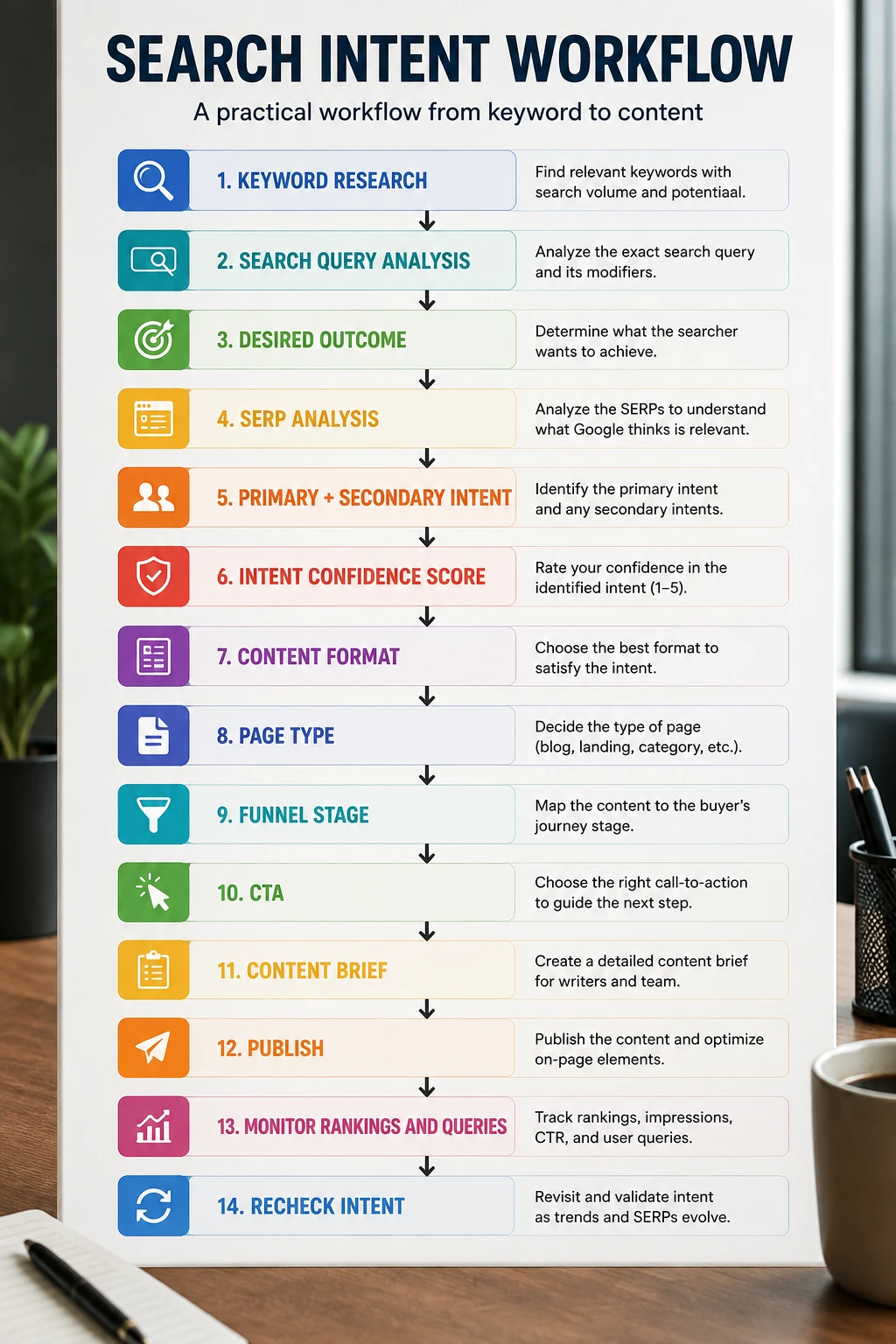
This process gives every important keyword a strategic role.
It also creates a useful bridge between traditional SEO, AEO, local SEO, and GEO.
For traditional SEO, you match the page to the SERP.
For AEO, you make important questions and answers clear.
For local SEO, you connect intent with geographic relevance.
For GEO, you build useful, structured, trustworthy information that can support AI-generated answers and recommendations.
The goal isn't to create content that simply contains a keyword.
The goal is to create the right answer for the right search need in the right format.
When you get that right, keyword research, content strategy, internal linking, conversion optimization, and AI-search visibility start working from the same strategy.

I’m an SEO Specialist, Content Writer, and Digital Marketing Professional with expertise in technical SEO, keyword research, content strategy, and WordPress. I create high-quality, SEO-optimized content that helps businesses improve organic visibility, attract the right audience, and grow through search and AI-powered discovery.
Hello there I am so grateful I found your blog page, I really found you by mistake, while I was researching on Aol for something
else, Anyways I am here now and would just like to say thank you for a fantastic post and a
all round exciting blog (I also love the theme/design), I don’t
have time to go through it all at the moment but I have saved it and also added in your RSS feeds, so when I have time I will be back to read more,
Please do keep up the great job.