


Publishing more content does not automatically mean getting more organic traffic.
You can write a detailed article, optimize the title, add internal links, improve page speed, and follow every basic SEO recommendation and still struggle to reach the first page of Google.
I’ve seen this happen repeatedly while working on SEO campaigns. A page can look perfectly optimized on the surface, yet fail to gain traction simply because we chose the wrong keyword to target in the first place.
Often, the problem begins before the content is written.
The keyword may be too competitive. The search intent may not match the page. The topic may have little business relevance. Or the search results may be dominated by websites your site is not yet strong enough to compete against.
Effective keyword research is therefore not simply about finding phrases with search volume.
It is about identifying search opportunities where relevance, demand, ranking potential, and business value overlap.
This guide walks through a practical keyword research process you can use to move from broad ideas to prioritized keywords, topic clusters, mapped URLs, and an actionable content plan designed to generate more Google impressions.
Keyword research is one part of a complete SEO strategy. If you’re building your SEO knowledge from the ground up, start with our complete SEO guide to understand how keyword research connects with content, on-page SEO, technical SEO, and link building.
Start With Your Business, Not a Keyword Tool
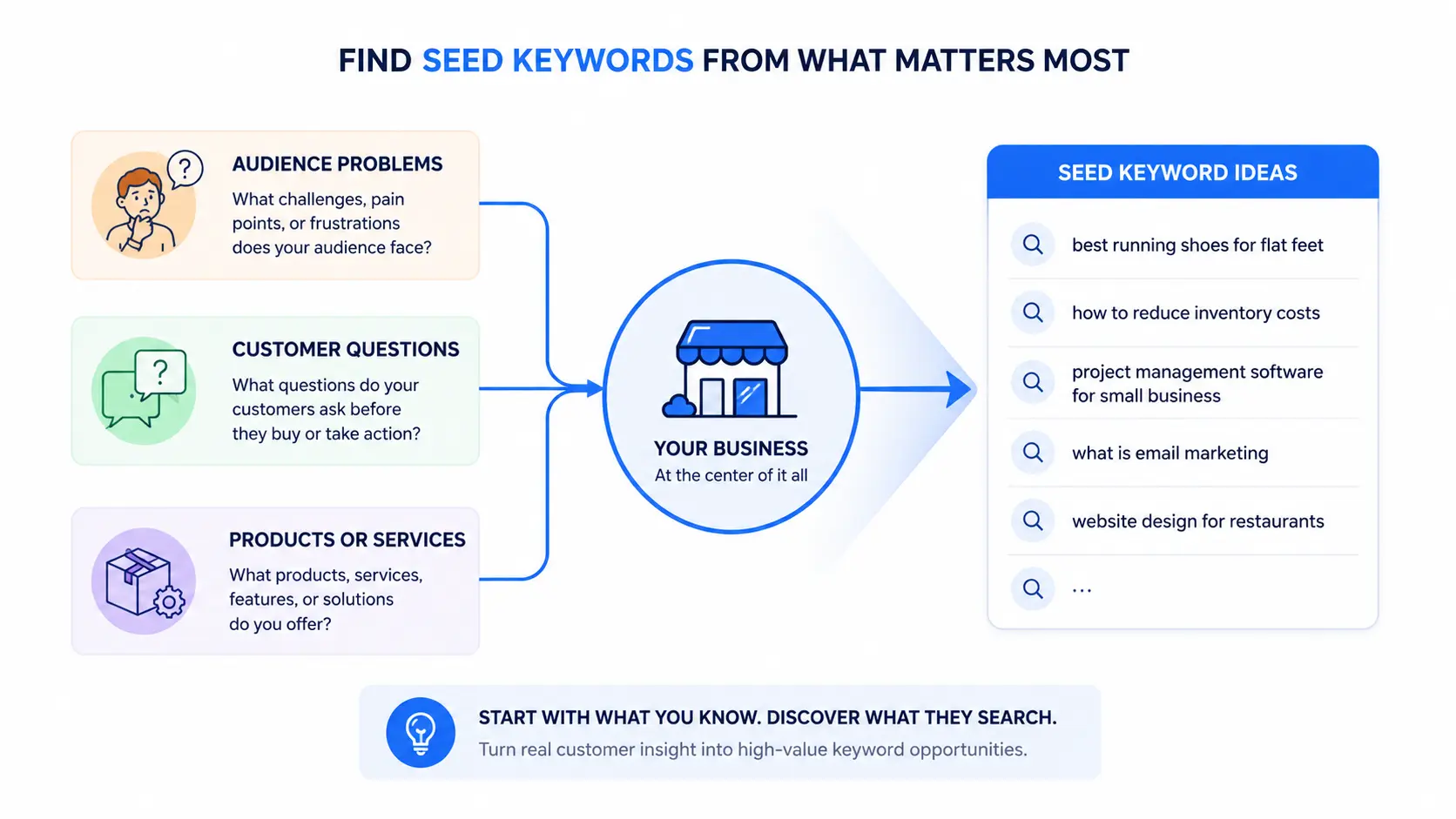
Opening a keyword research tool should not be your first step.
Keyword tools are excellent at expanding ideas, but they do not fully understand your customers, expertise, positioning, or business goals.
If you begin with a broad keyword and simply export thousands of related terms, you may end up with an impressive spreadsheet containing very few keywords that actually matter.
Start with the business and audience first.
Define the Audience You Actually Want to Attract
Traffic only becomes valuable when it brings the right people.
Before researching keywords, define who you want your content to reach.
Consider:
- Who is the ideal reader or customer?
- What are they trying to accomplish?
- What problems repeatedly slow them down?
- What knowledge do they already have?
- What questions appear before they choose a solution?
- What would make them trust your expertise?
For example, imagine a website offering SEO consulting.
A broad audience could include anyone interested in marketing.
A useful target audience is much narrower:
Small business owners and marketing teams who want to increase organic visibility but lack the expertise or resources to manage SEO effectively.
That definition immediately produces better research directions:
- SEO for small businesses
- Why website traffic is dropping
- How to improve local rankings
- SEO audit checklist
- How much SEO costs
- When to hire an SEO consultant
The closer your keyword research reflects real audience problems, the more commercially useful your content strategy becomes.
Turn Customer Problems Into Seed Topics
Customers rarely describe their problems using perfectly formatted SEO keywords.
They describe situations.
A business owner might say:
“My website has been online for six months, but I barely get visitors from Google.”
That statement contains several possible search topics:
- website not getting traffic
- why website is not ranking
- how long does SEO take
- improve Google rankings
- increase organic traffic
Collecting these problems before opening a keyword tool gives your research direction.
Products and Services
Start with what you actually provide.
For an SEO business, that might include:
- SEO consulting
- Technical SEO audits
- Local SEO
- Keyword research
- Content strategy
- On-page optimization
Do not stop at service names.
Ask what someone might search before realizing they need that service.
Someone may never search “technical SEO audit.”
Instead, they may search:
- why pages are not indexed
- website crawling issues
- Core Web Vitals problems
- sudden organic traffic drop
Those searches can lead naturally toward the service.
Pain Points and Questions
List the questions your target audience repeatedly asks.
Examples:
- Why is my website not ranking?
- Why did my traffic suddenly drop?
- How do I choose keywords?
- How many keywords should I target?
- Why is Google not indexing my pages?
- How can I compete with bigger websites?
These questions are valuable because they represent actual needs rather than abstract keyword ideas.
Problems Before and After Purchase
Keyword opportunities exist across the entire customer experience.
Before buying, people might ask:
- Do I need SEO?
- How much does SEO cost?
- SEO freelancer vs agency
- How long does SEO take?
After buying or implementing something, their questions change:
- How do I measure SEO results?
- Why are rankings fluctuating?
- How often should SEO be audited?
- How do I track keyword performance?
Researching both stages helps you build content that supports the full customer journey.
Build Your First Seed Keyword List
Seed keywords are broad topics used to generate deeper keyword ideas.
Start with approximately 10–30 closely related concepts rather than hundreds of random phrases.
For an SEO-focused website, a starting list might contain:
- keyword research
- technical SEO
- on-page SEO
- link building
- local SEO
- SEO audit
- content optimization
- Google rankings
- organic traffic
- Search Console
These are starting points—not necessarily final target keywords.
The next stage is expansion.
Build a Keyword Universe From Multiple Data Sources
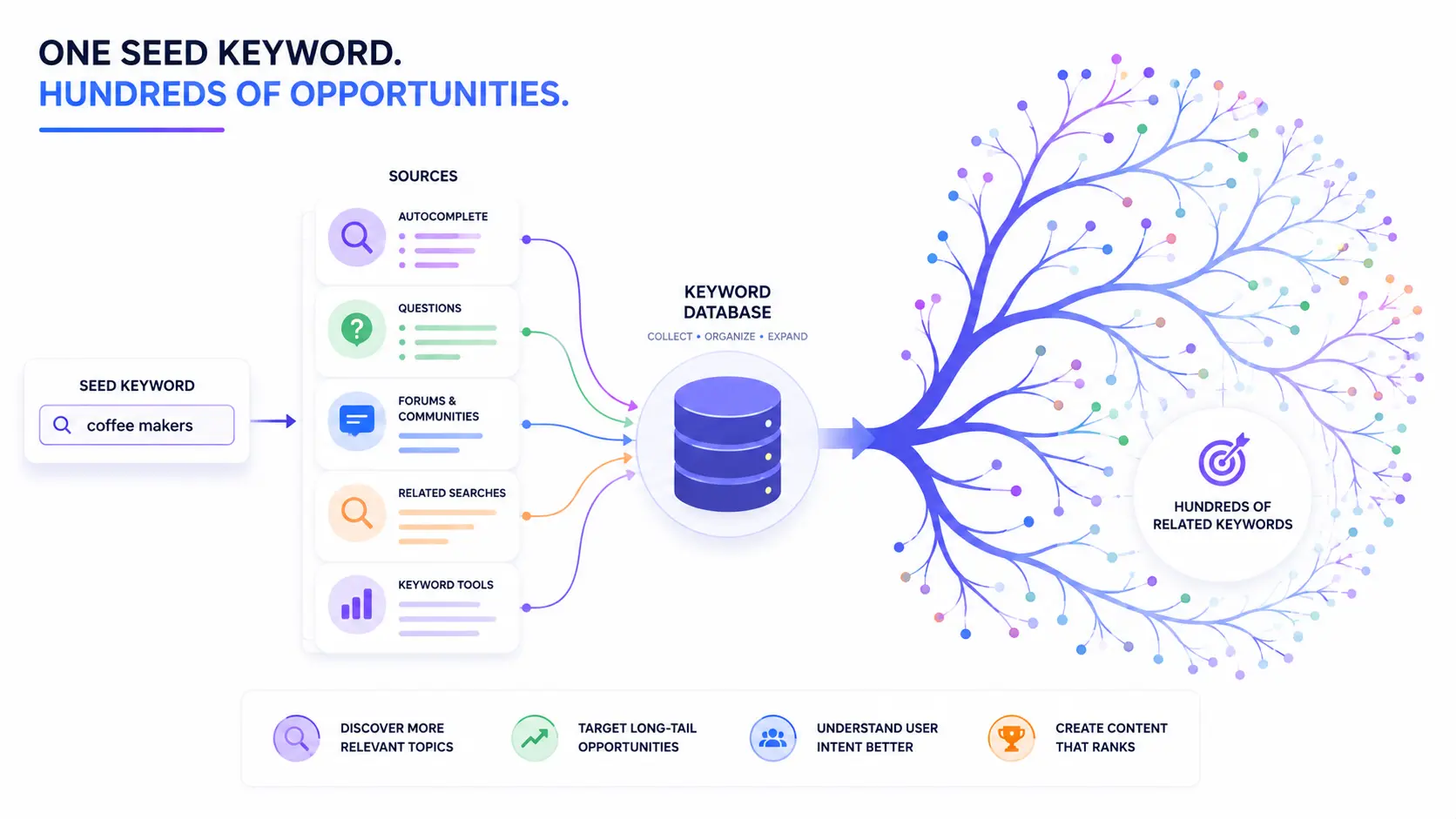
A keyword universe is a broad collection of relevant searches surrounding your business, audience, products, problems, and topics.
The biggest mistake here is relying on one source.
Every research method reveals different information.
Keyword tools provide metrics.
Google reveals search behavior.
Communities reveal audience language.
Competitors reveal proven topics.
Your own analytics reveal opportunities unique to your website.
Combining these sources produces a stronger dataset.
Mine Google Autocomplete for Real Search Patterns
Start typing a seed topic into Google and observe the suggestions.
For example:
keyword research...
You may see variations related to tools, beginners, SEO, methods, or specific use cases.
Try modifiers:
- how
- why
- best
- for
- vs
- without
- checklist
- examples
- template
You can also place different letters after your seed phrase to uncover additional patterns.
Autocomplete is particularly useful for discovering long, conversational queries that may not immediately appear in traditional brainstorming.
Do not assume every suggestion deserves a page.
Collect first. Validate later.
Extract Questions From People Also Ask
People Also Ask results can reveal how one search leads to another.
Suppose you research a topic around keyword selection.
Related questions might explore:
- How do I know if a keyword is good?
- What makes a keyword difficult?
- How many keywords should a page target?
- How do I find easy keywords?
Each question can serve several purposes.
It might become:
- A subsection
- An FAQ
- A supporting cluster article
- A definition
- A future content idea
Look for recurring themes rather than collecting questions blindly.
If many questions revolve around keyword competition, that suggests users need deeper guidance on evaluating ranking feasibility.
Find Hidden Opportunities in Related Searches
Related searches often expose adjacent topics.
These are useful when you want to understand how Google connects your main topic with nearby concepts.
For example, research around “keyword research” may lead toward themes such as:
- Competitor keyword analysis
- Keyword mapping
- Search intent
- Long-tail research
- Content gaps
- Keyword clustering
Those relationships can help you build topical coverage rather than isolated posts.
Use Reddit, Quora, and Communities for Audience Language
SEO tools tell you what people search.
Communities often tell you why they search.
Look through relevant discussions and pay attention to repeated frustrations, terminology, comparisons, objections, and follow-up questions.
Someone might write:
“Every keyword tool says the difficulty is low, but the first page is full of huge websites. How is that an easy keyword?”
That is more than a discussion.
It reveals a real content problem:
Why keyword difficulty scores can be misleading.
Community research is especially valuable for discovering:
- Unusual long-tail topics
- Emerging problems
- Real customer vocabulary
- Objections
- Comparison questions
- Topics keyword databases may underestimate
Use communities for insight—not as your only source of search-demand data.
Expand Seed Terms With Keyword Research Tools
Once you have audience-driven seed topics, use keyword tools to expand them systematically.
Google Keyword Planner
Google Keyword Planner can help discover related keyword ideas and broad demand patterns.
It is particularly useful when researching commercially relevant terms and variations around products or services.
Treat its search-volume ranges as directional rather than absolute predictions.
Ahrefs
Ahrefs can help analyze:
- Keyword ideas
- Ranking pages
- Parent topics
- Competitor keywords
- Traffic potential
- Backlinks
- SERP competition
One useful approach is to examine the pages already ranking—not merely the keyword metrics.
A keyword may look easy numerically while the actual SERP tells a very different story.
Semrush
Semrush provides keyword discovery, competitive research, gap analysis, SERP data, and topic exploration.
Its competitive tools are particularly useful when you want to understand which topics consistently generate visibility for competing domains.
Free Keyword Research Tools
You do not need an expensive subscription to begin.
You can combine:
- Google Search
- Google Trends
- Google Search Console
- Keyword Planner
- Bing Webmaster Tools
- Free versions of keyword platforms
- Community research
A strong research process matters more than owning every tool.
Use Google Search Console to Find Keywords You Already Rank For
One of the best keyword databases is your own website performance.
Google Search Console shows queries for which Google already considers your pages relevant.
That makes it extremely useful for identifying opportunities that generic keyword tools cannot personalize to your site.
Find High-Impression, Low-Click Queries
Open the Performance report and examine queries with:
- Significant impressions
- Low click-through rates
- Positions where improvement is realistic
High impressions with few clicks can indicate several possibilities.
Your page may rank too low.
Your title may not attract clicks.
Your content may only partially satisfy the query.
Or Google may be testing your page for a related topic you have not covered deeply enough.
Do not automatically rewrite the title whenever CTR is low.
First examine the query, ranking position, SERP layout, and search intent.
Discover Keywords Ranking on Page Two
Queries ranking around positions 11–20 can be especially interesting.
Google already understands that your page is relevant.
Instead of creating a new page immediately, investigate whether the existing URL can be improved.
Ask:
- Does the page fully answer the query?
- Is important information missing?
- Is the content outdated?
- Does the title reflect the search intent?
- Are internal links pointing to the page?
- Are competing pages substantially stronger?
A move from position 14 to position 7 can produce far more value than publishing another page that takes months to establish.
Identify Quick-Win Optimization Opportunities
Search Console opportunities generally fall into several categories.
Improve Existing Content
If the page matches the intent but lacks depth, strengthen it.
Add useful examples, updated information, clearer explanations, original insights, tables, visuals, or practical steps.
Avoid adding paragraphs simply to increase word count.
Expand Missing Subtopics
A page may rank for related queries it barely addresses.
Those queries can reveal missing sections.
If a page about SEO audits receives impressions for “SEO audit checklist,” a useful checklist may improve relevance—provided it belongs naturally within the page.
Strengthen Internal Links
Internal links help search engines discover relationships between pages and indicate which URLs are important.
Link to priority pages from relevant content using descriptive, natural anchor text.
Do not force the same exact-match anchor across dozens of pages.
Reverse-Engineer Competitors to Find Proven Keywords
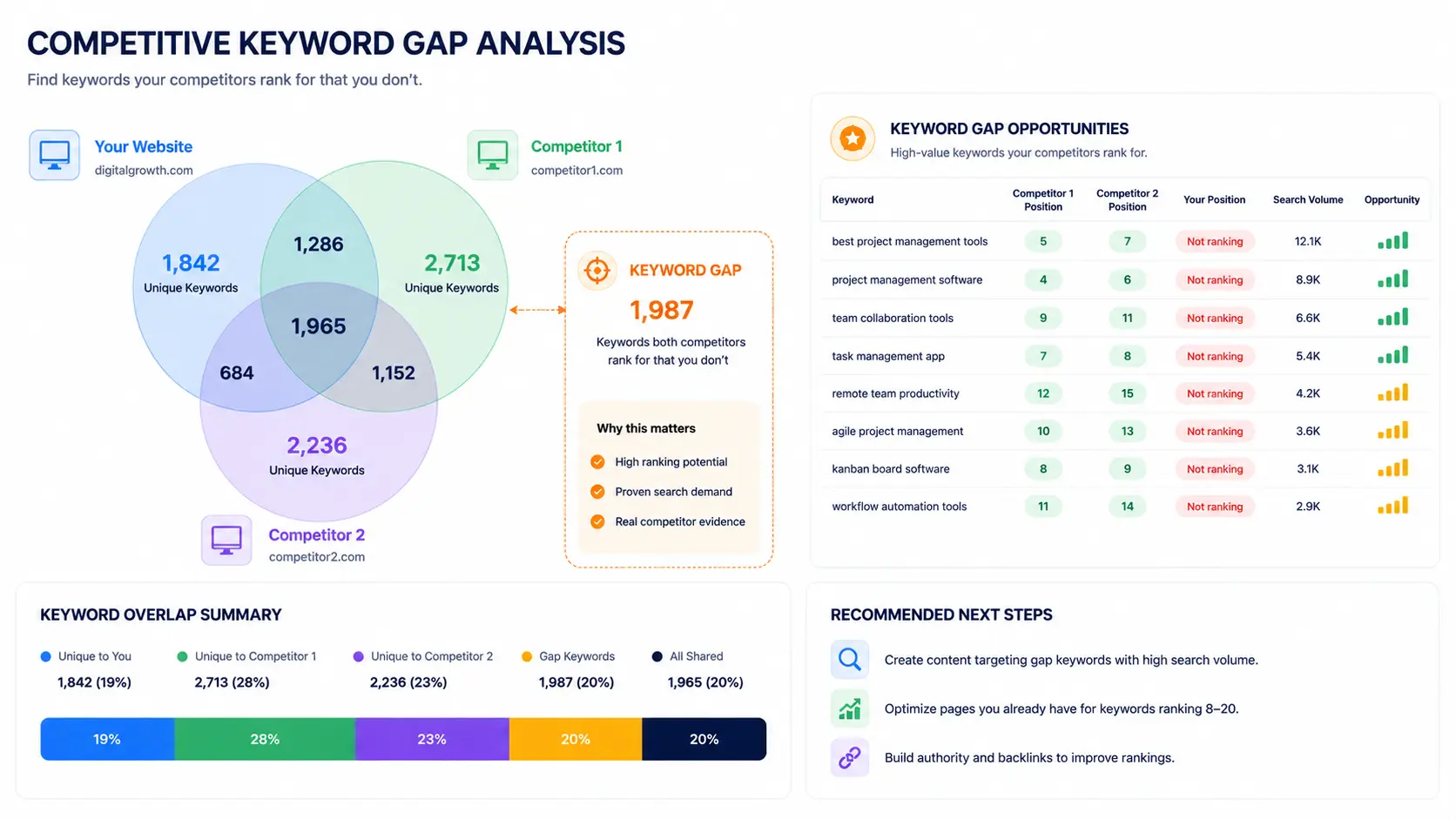
Competitor research reduces guesswork.
If another website consistently receives organic visibility from a topic, there is evidence that search demand exists.
But competitor analysis should not mean copying their keywords and recreating their articles.
Use competitors to discover opportunities—then build something more useful or differentiated.
Identify Your Real Organic Search Competitors
Your business competitors and search competitors are not always the same.
A local SEO consultant might compete commercially with other consultants.
But in Google results, the competing pages could come from:
- Marketing blogs
- SaaS companies
- SEO tool providers
- Agencies
- Publishers
Search your priority topics and identify domains that repeatedly appear.
Those are your organic competitors.
Find Keywords Competitors Rank For but You Don’t
A keyword gap analysis can reveal topics where competing domains have visibility and your site does not.
Do not export the entire list and start writing.
Filter opportunities by:
- Relevance
- Intent
- Ranking feasibility
- Business value
- Existing site coverage
- Topical fit
If a competitor ranks for 50,000 keywords, perhaps only 500 genuinely matter to your strategy.
Discover Their Highest-Traffic Pages
Pages often reveal more than individual keywords.
Find competitor URLs estimated to receive meaningful organic traffic.
Then investigate:
- What topic does the page cover?
- How many related queries does it rank for?
- What search intent does it satisfy?
- What format is used?
- Why might users prefer it?
- What important angle is still missing?
The goal is not:
“How can I copy this page?”
The better question is:
“What does this page prove about demand, and how can I provide a better or more specialized answer?”
Separate Keywords Worth Targeting From Keywords Worth Ignoring
Competitors rank for irrelevant keywords too.
Ignore topics that:
- Do not fit your audience
- Have weak business relevance
- Require expertise you cannot demonstrate
- Are dominated by a different intent
- Do not support your topical strategy
A smaller list of strategically aligned keywords is more useful than a massive export.
Analyze the SERP Before Choosing Any Keyword
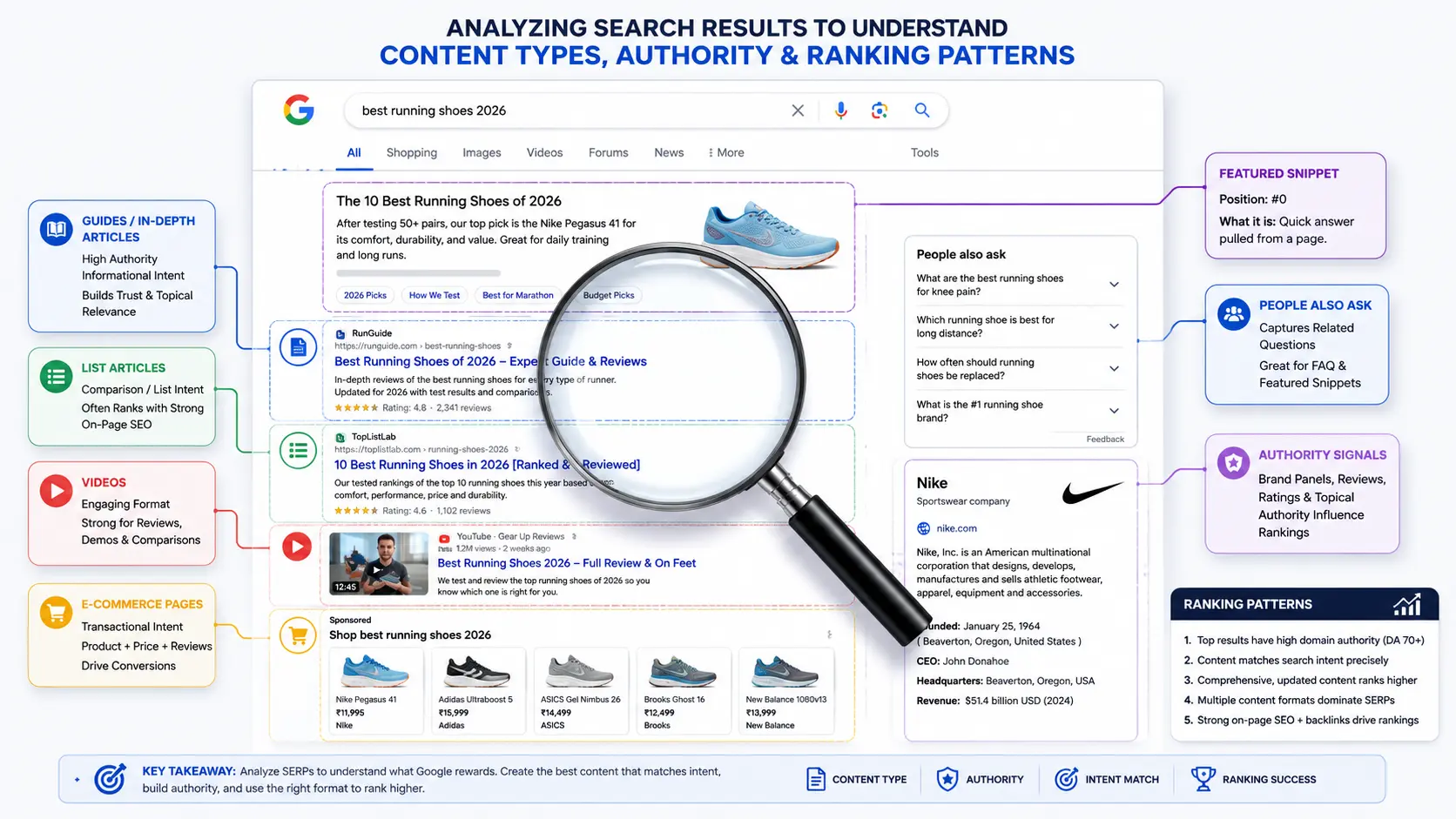
Keyword metrics are estimates.
The search results are reality.
Before committing to an important keyword, search it manually.
The SERP shows what Google currently believes users want.
Study What Google Is Already Rewarding
Review the top-ranking results.
Ask:
- What types of pages dominate?
- How closely do titles match the query?
- Are results recent?
- Are they beginner-friendly or advanced?
- Are major brands dominating?
- Are there niche sites ranking too?
- What questions do the pages answer?
- What appears to make these results useful?
Patterns matter.
If nearly every result solves the query in a similar way, publishing something completely different may struggle unless the existing SERP is poorly satisfying users.
Identify the Dominant Content Format
Search intent is often reflected in format.
Guides and Tutorials
“How to” searches frequently favor step-by-step educational content.
A short product page is unlikely to satisfy someone seeking a detailed tutorial.
List Posts
Queries containing terms such as “best,” “ideas,” or “examples” often favor lists because users want options.
Product or Service Pages
Commercial searches may favor category, service, or product pages rather than educational articles.
Trying to rank a blog post for a strongly transactional query can create an intent mismatch.
Tools and Calculators
Some searches are best answered through interaction.
If users want to calculate, check, generate, convert, or test something, a static article may be less useful than a functional tool.
Check Whether the SERP Is Realistically Beatable
Examine who ranks.
If every result belongs to globally authoritative domains with highly relevant pages and strong backlink profiles, a newer site may need a more specific angle.
Look for signs of opportunity:
- Smaller niche sites ranking
- Outdated pages
- Weak answers
- Forums appearing prominently
- Pages that only partially match intent
- Thin or poorly structured content
No single signal guarantees easy rankings, but together they provide a realistic picture.
Look Beyond Keyword Difficulty Scores
Keyword Difficulty is useful as a filter—not a verdict.
Different tools calculate difficulty differently, often emphasizing backlink data.
They may not fully capture:
- Domain authority differences
- Topical authority
- Search intent
- Content quality
- Brand preference
- SERP volatility
- Internal linking
- Your website's existing relevance
A keyword marked KD 15 is not automatically easy.
A KD 50 keyword is not automatically impossible.
Always pair tool metrics with manual SERP analysis.
Measure the True Ranking Opportunity of a Keyword
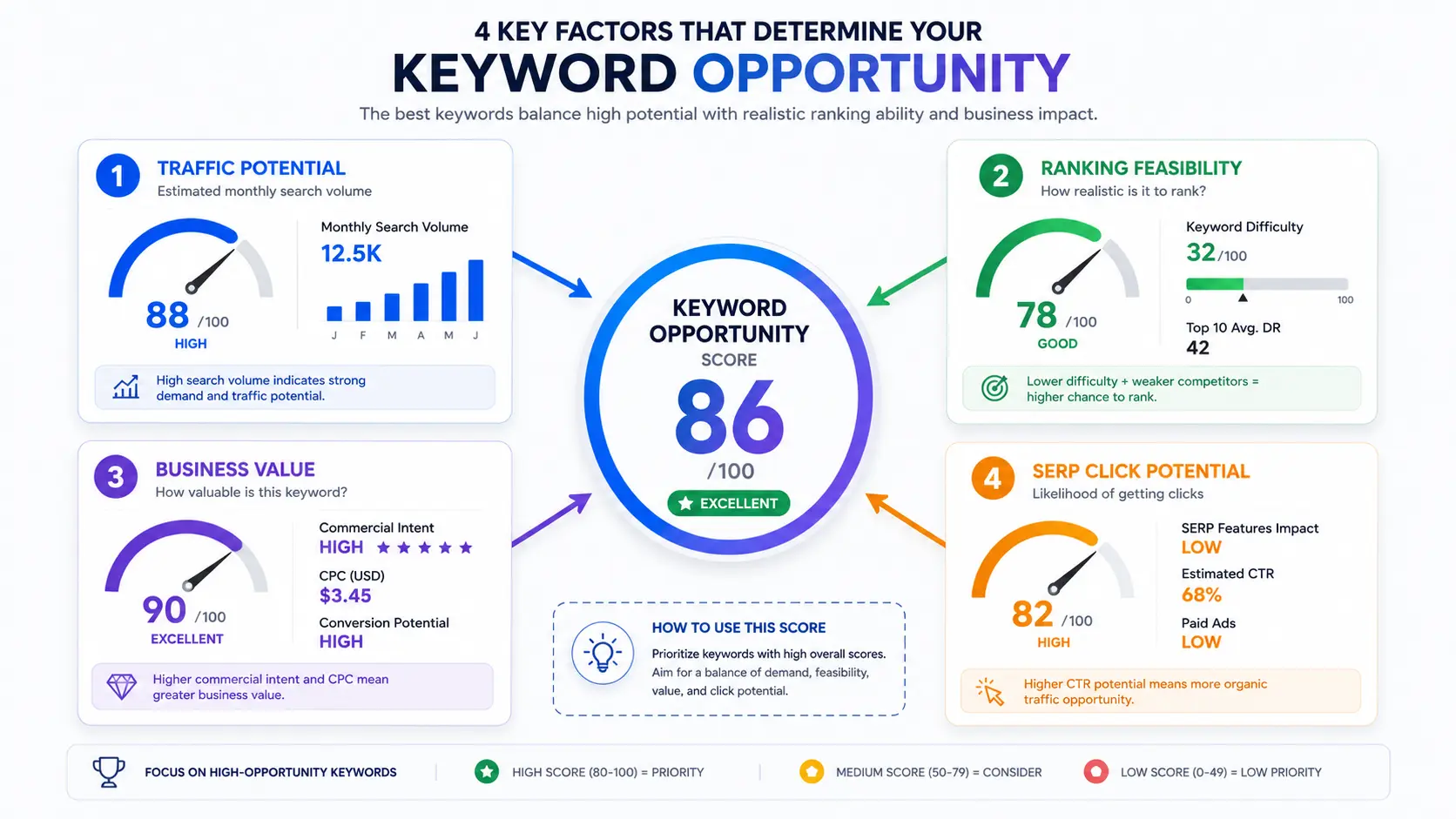
The best keyword is rarely the one with the largest search volume.
A valuable keyword sits at the intersection of four factors:
Relevance + Traffic Potential + Ranking Feasibility + Business Value
Evaluate Traffic Potential Beyond Search Volume
One page can rank for many related queries.
Therefore, monthly search volume for one keyword does not represent the page's full traffic potential.
Analyze the top-ranking pages.
If they receive traffic from dozens or hundreds of related queries, the topic may be much larger than the primary keyword suggests.
Think in terms of topic demand, not just exact-query volume.
Assess Business and Conversion Value
Ask what happens if you rank.
Will the visitor:
- Join your target audience?
- Subscribe?
- Request a quote?
- Discover your service?
- Move closer to a purchase?
- Become a returning reader?
A keyword with 300 highly relevant searches may be more valuable than one with 20,000 broad searches.
Traffic is a means—not the final objective.
Estimate Your Realistic Ranking Ability
Consider your current position.
Evaluate:
- Website authority
- Existing topical coverage
- Content quality
- Backlink profile
- Brand recognition
- Internal linking
- First-hand expertise
- Resources available to create the page
Newer websites often benefit from building authority through narrower, well-defined topics before competing for broad head terms.
Identify SERP Features That Can Reduce Organic Clicks
Not every search produces the same click opportunity.
A SERP may include:
- Ads
- Featured snippets
- AI-generated answers
- Videos
- Maps
- Shopping results
- People Also Ask
- Image packs
A keyword may have high search volume but limited organic click potential.
Search volume therefore needs context.
Prioritize Keywords With an Opportunity Score
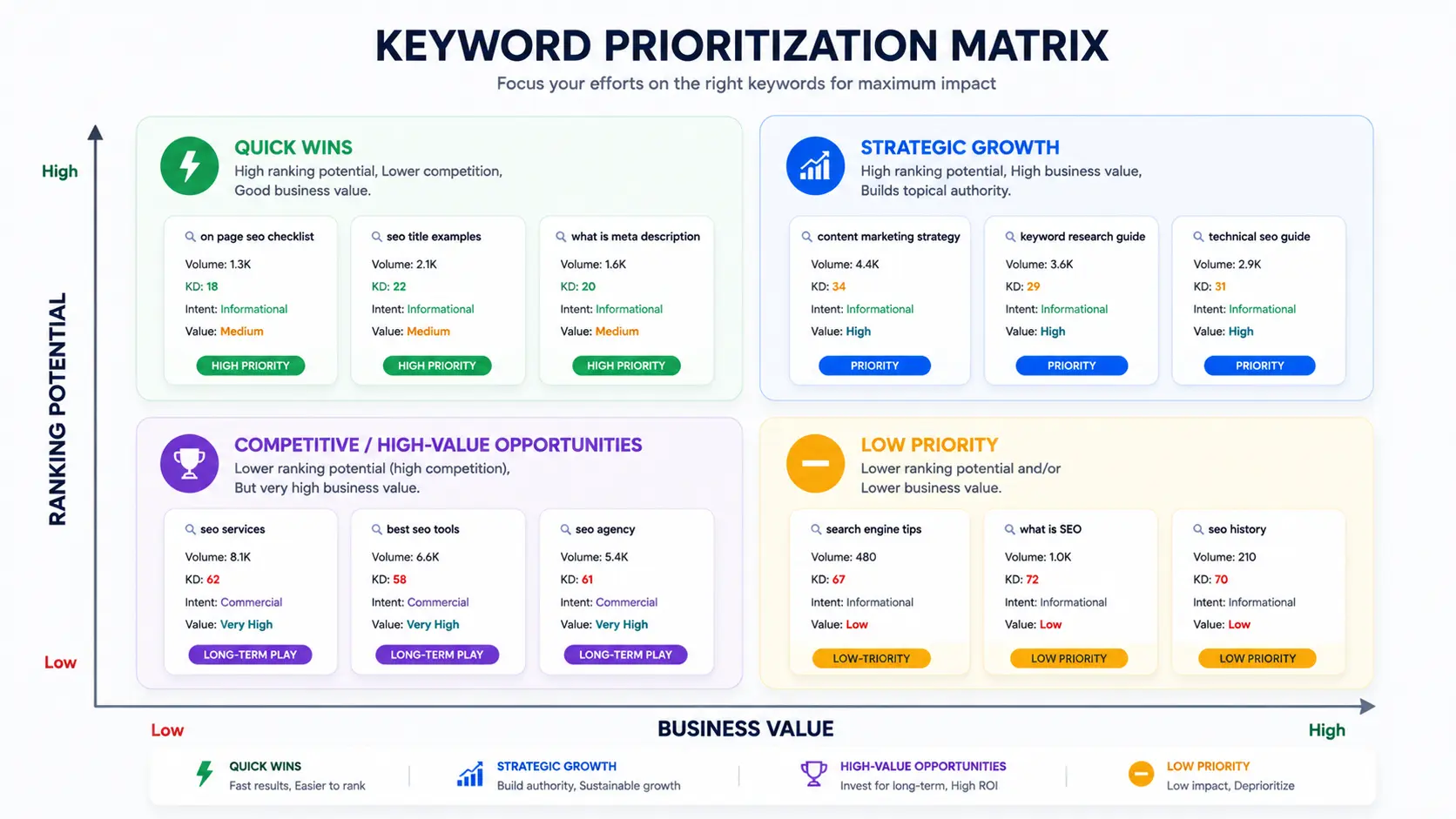
Once you collect hundreds of keywords, prioritization becomes the real challenge.
A simple scoring system can turn a chaotic spreadsheet into an actionable plan.
Score Keywords by Relevance
Use a scale such as 1–5.
5: Directly aligned with your audience and expertise
3: Related but not central
1: Weak connection
Relevance should carry significant weight.
Ranking for irrelevant traffic rarely creates meaningful results.
Score Keywords by Ranking Potential
Consider:
- SERP strength
- Your existing authority
- Content gaps
- Quality of current results
- Backlink expectations
Again, score from 1–5.
Do not base this entirely on KD.
Score Keywords by Business Value
Ask how closely the topic connects to an outcome that matters.
For an SEO consultant:
“SEO consultant pricing” may have strong commercial value.
“History of search engines” may have much lower direct business value.
Both can generate traffic, but they serve different purposes.
Create a Simple Keyword Priority Matrix
Combine your scores to classify opportunities.
Quick Wins
High relevance + realistic competition + useful demand.
Prioritize these first.
Strategic Growth Keywords
Important topics that may require stronger supporting content and authority.
Build toward them through clusters.
High-Value Competitive Keywords
Commercially valuable but difficult.
These may justify long-term investment.
Keywords to Ignore
Low relevance, poor intent alignment, unrealistic competition, or little strategic value.
Saying “no” is part of good keyword research.
Group Keywords Into Topics Instead of Creating One Page Per Keyword
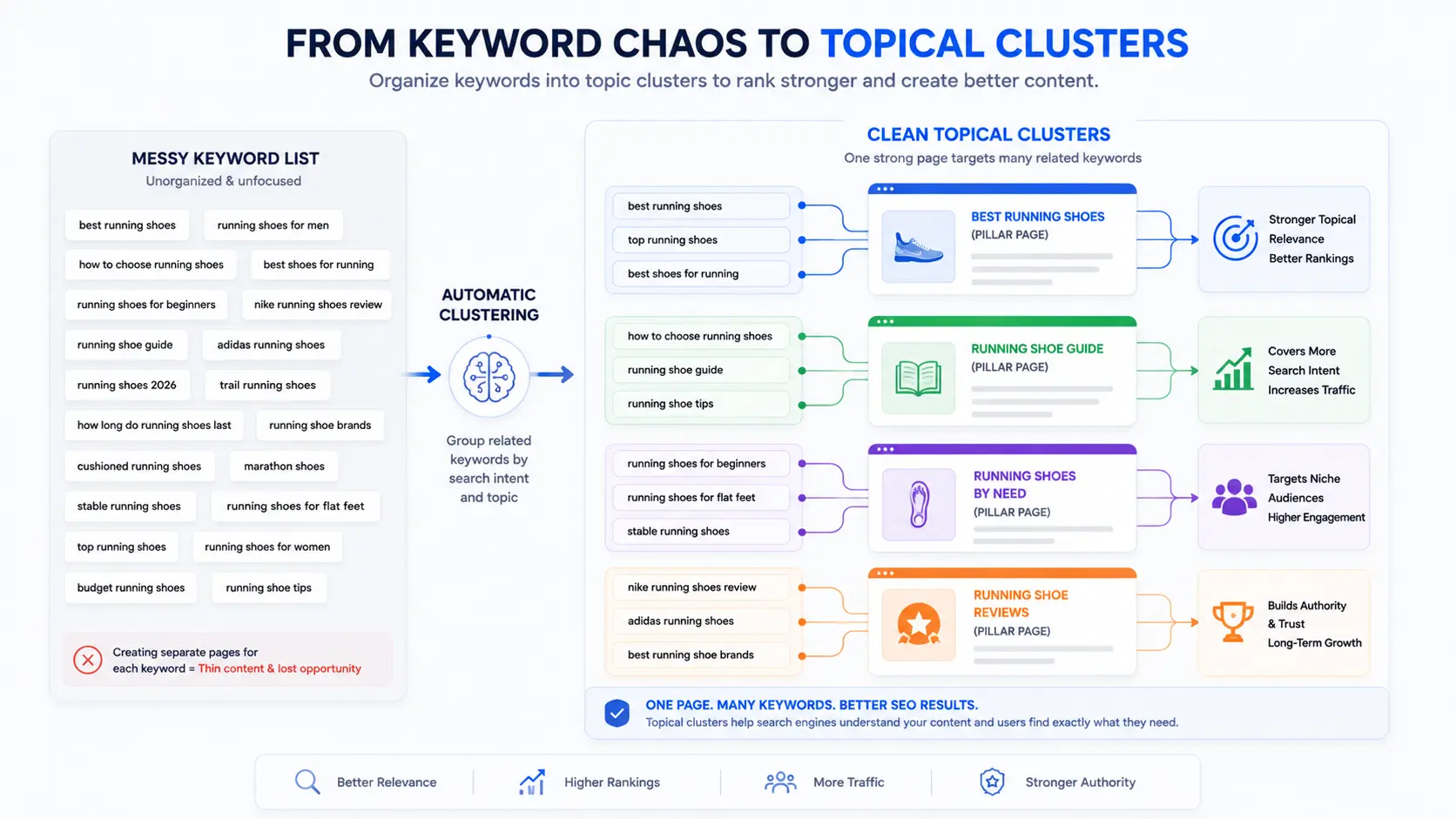
Modern keyword research should produce topics—not hundreds of nearly identical URLs.
Imagine discovering:
- keyword research process
- how to research keywords
- keyword research steps
- how to do keyword research
Should each phrase get a separate article?
Usually not.
They likely represent the same underlying search goal.
Identify Keywords With the Same Search Goal
Search each variation.
If Google returns mostly the same pages, that is strong evidence the keywords belong together.
This is sometimes called SERP overlap.
Decide When Keywords Belong on One Page
Combine keywords when:
- Intent is the same
- Ranking pages overlap substantially
- One comprehensive page can satisfy all variations
- Separate pages would repeat most of the same information
Choose one primary topic and incorporate related terminology naturally.
Know When a Keyword Needs Its Own Page
Separate pages make sense when:
- Intent differs
- The user expects a different format
- The topic requires substantial independent depth
- SERPs show different ranking pages
For example:
“keyword research guide” and “keyword research tools” are related.
But the first may require a process-focused tutorial, while the second may deserve a dedicated comparison.
Prevent Keyword Cannibalization Before It Happens
Keyword cannibalization occurs when multiple pages compete for the same or highly similar search intent.
Before creating a new URL, search your site.
Ask:
- Do I already have a page targeting this intent?
- Should I update that page instead?
- Would the new page provide something meaningfully different?
- Could both pages confuse search engines about which URL should rank?
A keyword map can prevent this problem.
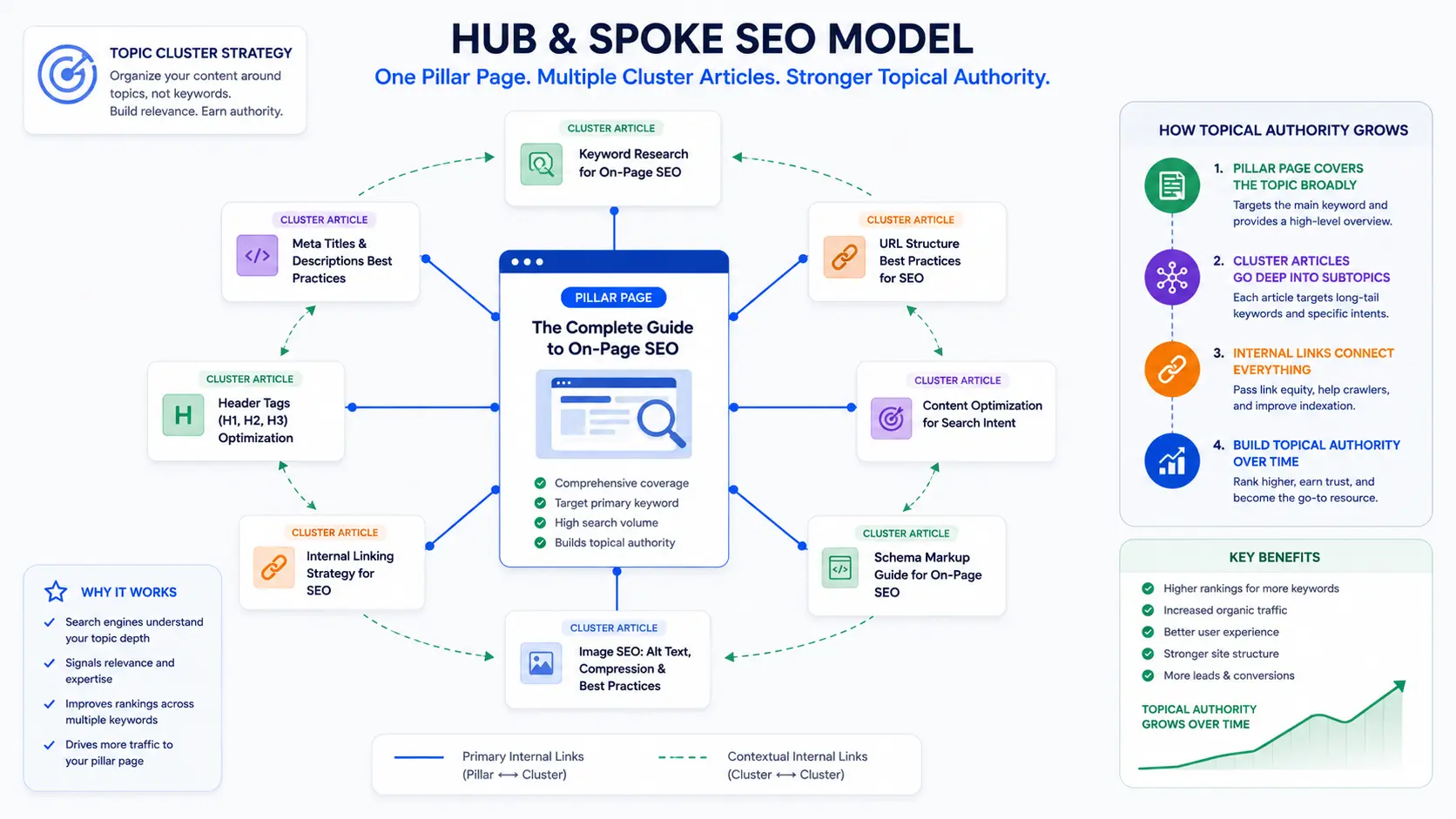
Individual keywords should fit into a broader information architecture.
A topic cluster organizes related pages around a central subject.
Choose a Strong Pillar Topic
A pillar should represent a broad topic important to your audience.
For example:
SEO Guide
Supporting clusters could cover:
- Keyword research
- Search intent
- On-page SEO
- Technical SEO
- Link building
- Local SEO
- SEO tools
Each cluster explores a narrower subject in greater depth.
Find Supporting Cluster Opportunities
For every pillar topic, ask:
- What does a beginner need to understand?
- What problems occur during implementation?
- What comparisons do people make?
- What advanced questions appear later?
- What tools or processes deserve dedicated coverage?
These questions generate natural cluster opportunities.
Map Supporting Content Around the Pillar
Avoid publishing clusters randomly.
Visualize the relationship:
Pillar: Complete SEO Guide
→ Keyword Research
→ Search Intent
→ On-Page SEO
→ Technical SEO
→ Link Building
→ Local SEO
Then create deeper supporting articles where necessary.
This builds a logical content ecosystem.
Connect the Cluster With Strategic Internal Links
Internal links should reflect these relationships.
Pillar-to-Cluster Links
The pillar introduces a topic and directs readers to the detailed cluster guide.
Cluster-to-Pillar Links
The cluster links back to the broader guide when readers need context.
Contextual Links Between Related Articles
Related cluster pages should link naturally when one topic helps explain another.
For example, a keyword research article can link to a detailed search-intent guide when discussing intent validation.
The goal is usefulness and clear topical relationships—not adding links simply because an SEO checklist says you need them.
Create a Keyword Map Before Writing Content
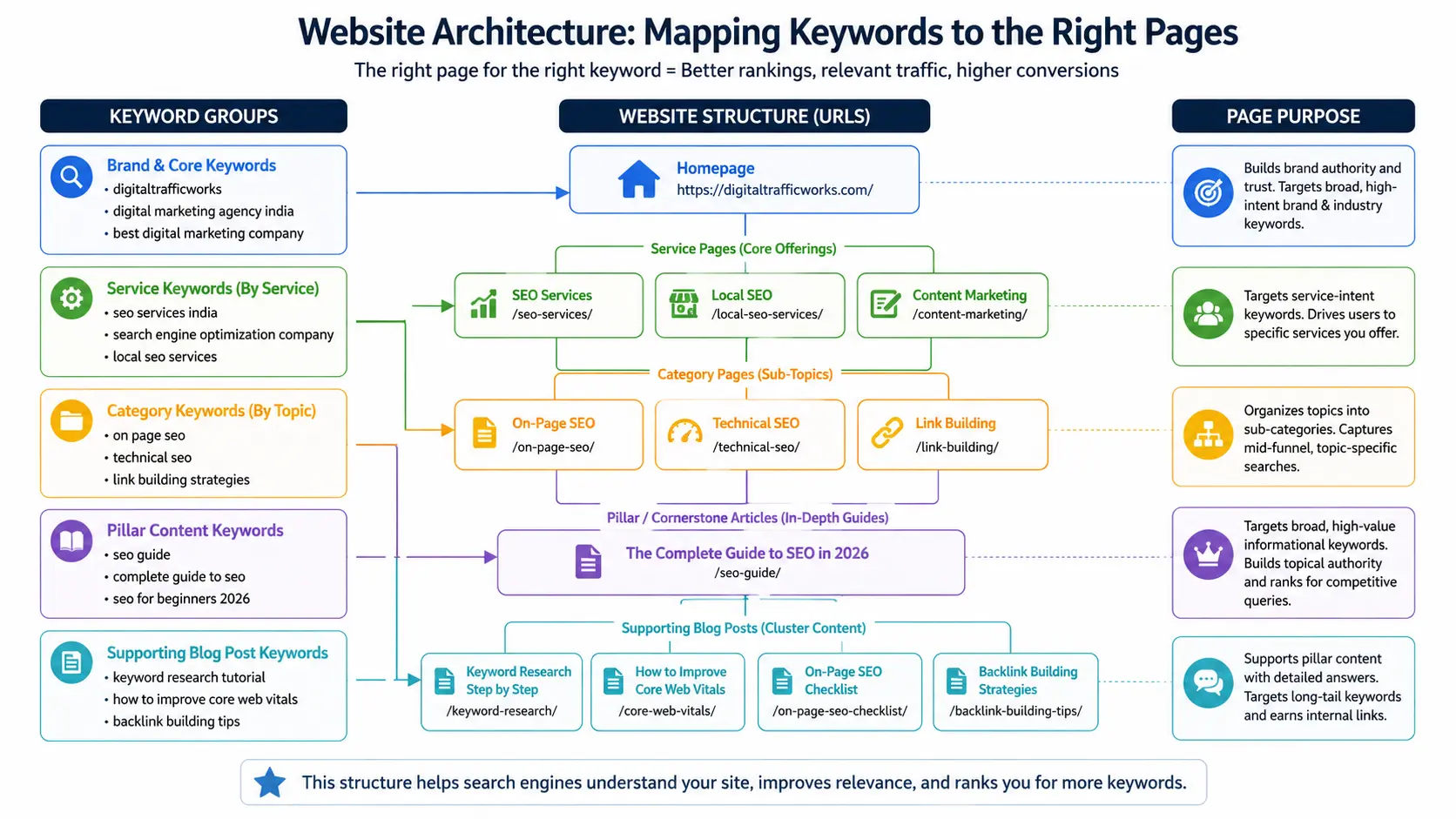
A keyword map assigns topics and search intents to specific URLs.
This helps prevent duplication and gives every page a clear purpose.
Useful columns might include:
| URL | Primary Topic | Search Intent | Cluster | Priority | Status |
| /seo-guide/ | SEO guide | Informational | SEO | High | Published |
| /keyword-research/ | Keyword research | Informational | SEO | High | Planned |
| /search-intent/ | Search intent | Informational | SEO | High | Planned |
The exact spreadsheet format matters less than maintaining clarity.
Assign One Search Goal to Each URL
Every URL should have a dominant purpose.
A page can rank for many keywords, but those keywords should generally support the same intent.
Map Primary Topics and Supporting Terms
Do not obsess over assigning dozens of exact-match secondary keywords.
Instead, map:
- Primary topic
- Search intent
- Important subtopics
- Related questions
- Supporting entities and concepts
Then write naturally around the subject.
Match Keywords to the Customer Journey
Not every keyword serves the same stage.
Awareness Keywords
The user is discovering a problem.
Examples:
- why website traffic dropped
- what is keyword cannibalization
Consideration Keywords
The user is evaluating approaches.
Examples:
- best keyword research methods
- SEO audit tools comparison
Decision Keywords
The user is closer to taking action.
Examples:
- hire SEO consultant
- SEO audit service pricing
A healthy content strategy covers multiple stages rather than chasing only informational traffic.
Build a 90-Day Content Roadmap
Once keywords are scored and mapped, turn research into a publishing schedule.
For example:
Month 1: Publish high-relevance quick wins.
Month 2: Strengthen clusters around existing pillar pages.
Month 3: Target more competitive strategic topics while updating early content based on Search Console data.
Prioritize logical topical growth over random publishing frequency.
Use AI for Keyword Research Without Trusting It Blindly
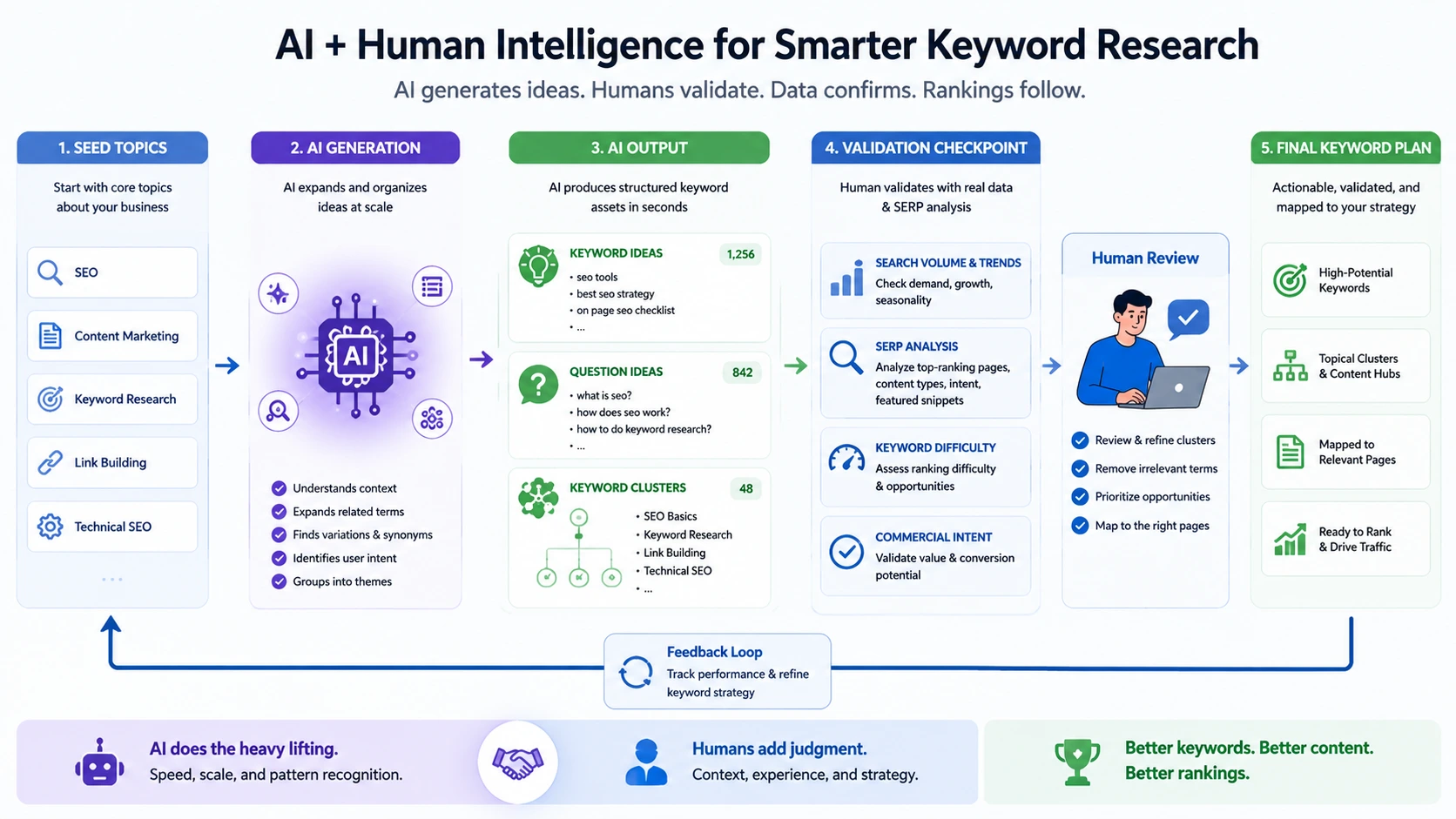
AI can dramatically speed up parts of keyword research.
But it should assist discovery and organization—not replace real search data.
Use AI to Expand Seed Topics
Give AI clear context about:
- Your business
- Audience
- Product
- Problems
- Existing content
Then ask for potential topic directions.
AI is particularly useful for brainstorming angles you may have overlooked.
Discover Questions and Subtopics Faster
AI can help generate questions from different perspectives:
- Beginner
- Advanced user
- Buyer
- Small business owner
- Technical professional
These suggestions can reveal useful research directions.
Cluster Large Keyword Lists With AI
If you have hundreds of keywords, AI can help group them by:
- Topic
- Intent
- Funnel stage
- Similar meaning
This can save hours of spreadsheet work.
But clustering should still be checked against actual SERPs.
Two phrases may sound similar linguistically while Google treats them as different intents.
Validate AI Suggestions With Real Search Data
Never publish based solely on an AI-generated keyword list.
Verify Search Demand
Use Search Console, Keyword Planner, SEO tools, Google Trends, or other available datasets.
Check the Live SERP
Search the keyword.
Examine intent, competitors, formats, and SERP features.
Confirm Audience Relevance
Ask whether the topic genuinely helps the people you want to attract.
AI can generate thousands of plausible ideas.
Your job is deciding which ones deserve resources.
Keyword Research Example: From Seed Topic to Content Plan
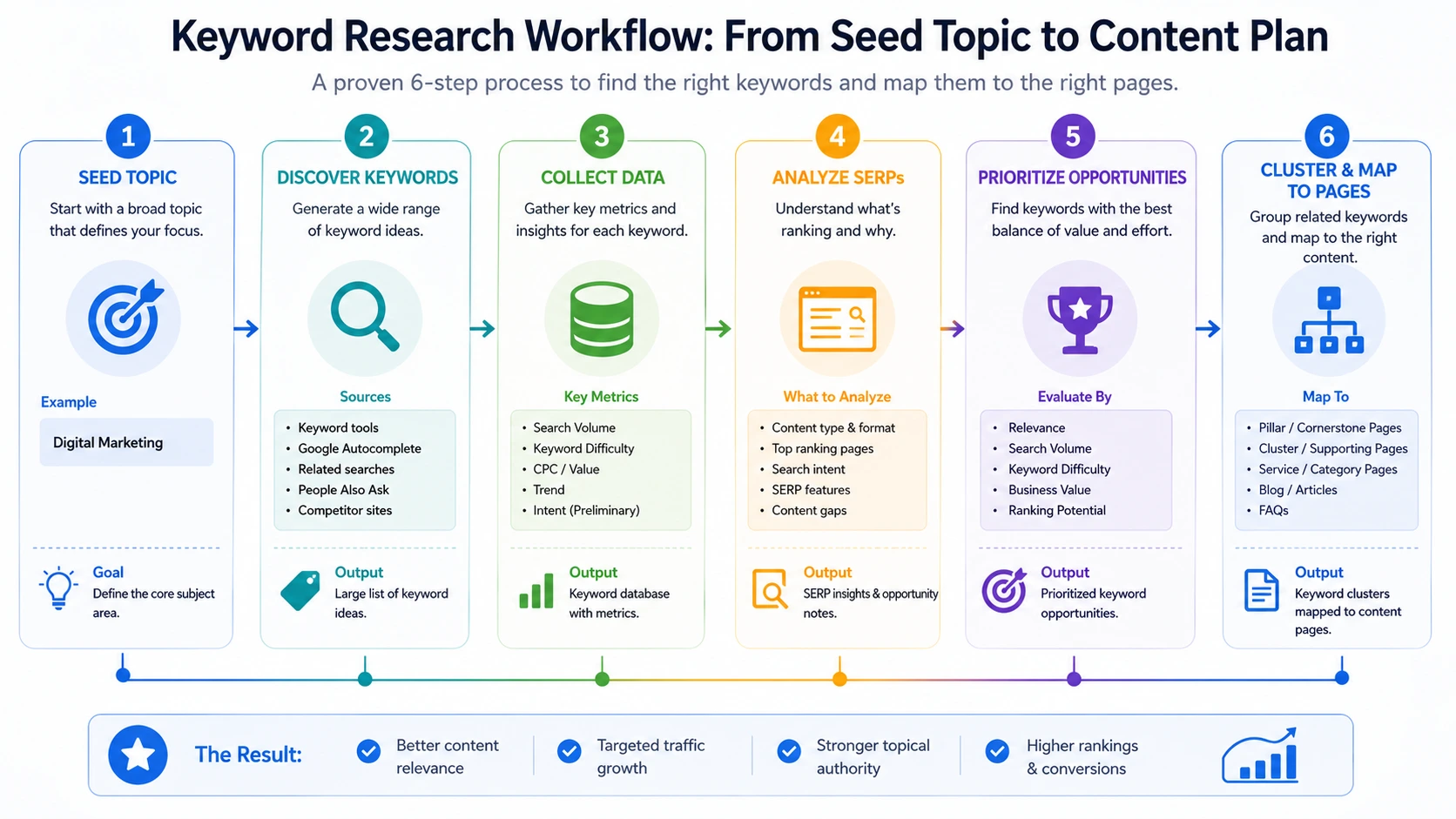
Here is a simplified example for a hypothetical website offering SEO guidance for small businesses.
Step 1: Choose a Seed Topic
Seed topic:
Local SEO
Step 2: Expand the Keyword Set
Research may reveal topics such as:
- local SEO for small business
- local SEO checklist
- Google Business Profile optimization
- local citation building
- how to rank in Google Maps
- local SEO audit
- local keyword research
Step 3: Validate the SERP
Search each topic manually.
Suppose “local SEO checklist” primarily returns detailed checklists, while “local SEO services” returns agency service pages.
Those keywords should not be targeted with the same page.
Intent differs.
Step 4: Score and Prioritize Opportunities
Evaluate each opportunity for:
- Relevance
- Ranking feasibility
- Business value
- Traffic potential
Suppose “local SEO checklist” receives a strong overall score.
It becomes a priority.
Step 5: Cluster Related Queries
Related searches such as:
- local SEO checklist for small business
- local search optimization checklist
- Google Maps SEO checklist
may belong on one comprehensive page if the SERPs and intent overlap.
Step 6: Map Keywords to Pages
The final structure might be:
Pillar: Local SEO Guide
Cluster pages:
- Local SEO Checklist
- Google Business Profile Optimization
- Local Keyword Research
- Local Citation Building
- How to Rank in Google Maps
- Local SEO Audit
Now keyword research has become an actual site architecture—not merely a spreadsheet.
A Repeatable Keyword Research Workflow
A reliable process makes keyword research easier to repeat.
Discover
Collect ideas from:
- Customer problems
- Search Console
- Competitors
- Communities
- Keyword tools
- AI brainstorming
Do not filter too aggressively yet.
Validate
Check:
- Search intent
- SERP composition
- Demand
- Relevance
- Ranking pages
Remove obvious mismatches.
Prioritize
Score opportunities based on:
- Relevance
- Ranking feasibility
- Traffic potential
- Business value
Decide what deserves attention first.
Cluster
Group searches with the same intent.
Use SERP overlap to determine whether keywords belong together.
Map
Assign clusters to:
- Existing URLs
- New pages
- Pillars
- Supporting articles
Prevent unnecessary duplication.
Create
Produce the page that best satisfies the search.
Focus on usefulness, clarity, first-hand expertise, original examples, and complete intent satisfaction.
Measure and Refresh
After publishing, monitor:
- Impressions
- Rankings
- Clicks
- CTR
- Conversions
- Queries gaining visibility
Use real performance data to refine the strategy.
Keyword research does not end when the article is published.
Publishing creates new data for the next research cycle.
Keyword Research Checklist Before You Publish
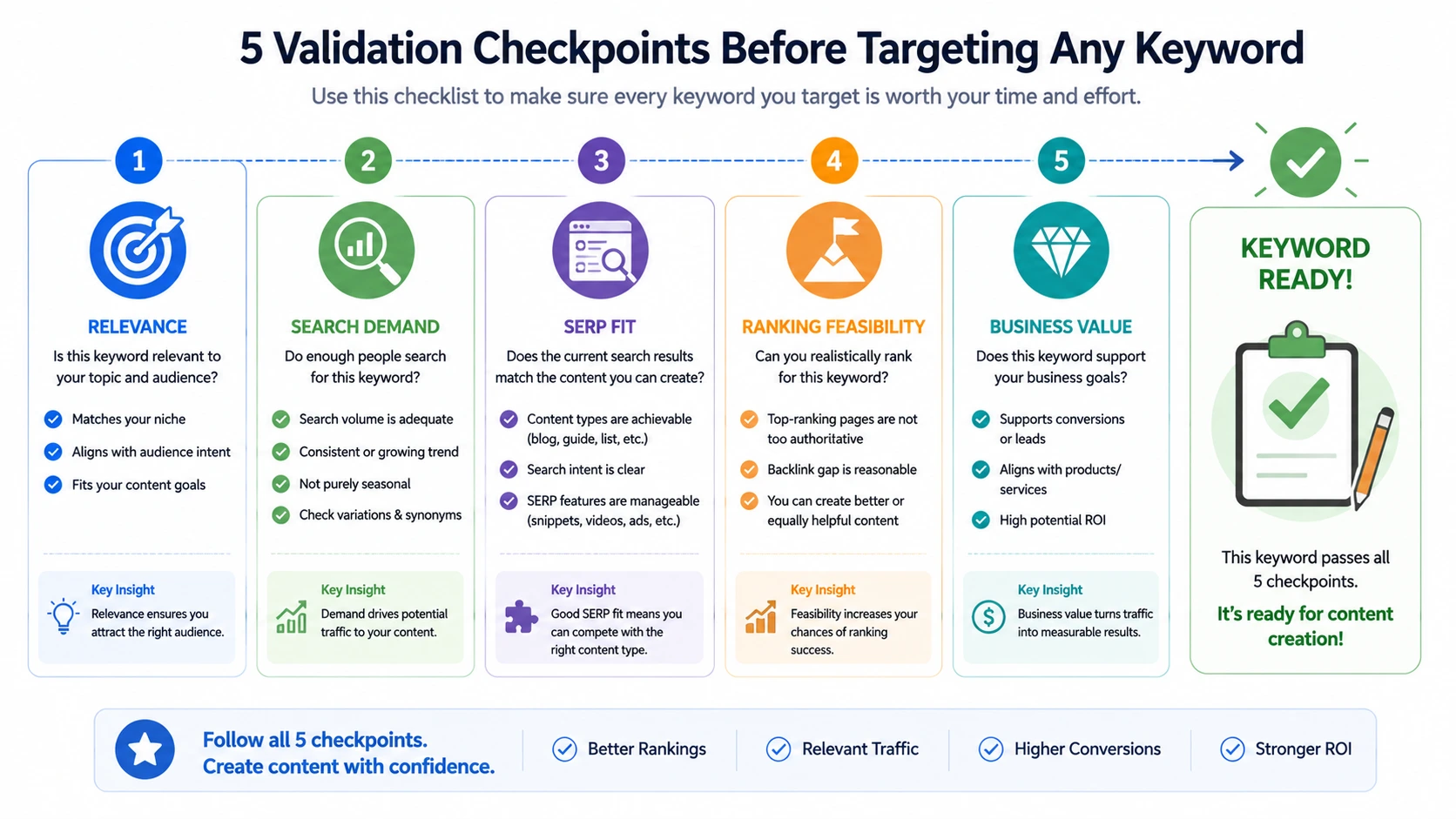
Before creating content for a target keyword, run through five checks.
Demand and Relevance Check
- Does the topic have evidence of demand?
- Is it relevant to the target audience?
- Does it fit the website's expertise?
- Is it strategically useful?
SERP Validation Check
- What intent dominates?
- What content format ranks?
- Who currently ranks?
- Are SERP features affecting clicks?
- Can you create something genuinely useful?
Ranking Feasibility Check
- Is competition realistic?
- Do smaller or comparable websites rank?
- What level of authority appears necessary?
- Can your site support the page with internal links and topical depth?
Content Mapping Check
- Does an existing URL already target this intent?
- Should you update an existing page?
- Does the keyword belong in a broader cluster?
- Could a new page create cannibalization?
Business Value Check
- Will this attract the right audience?
- Does it support a product, service, expertise area, or strategic goal?
- What should visitors do after reading?
If a keyword fails most of these checks, search volume alone is not a good reason to target it.
Frequently Asked Questions About Keyword Research
How do I do keyword research as a beginner?
Start with your audience rather than a tool.
Write down the products, services, problems, and questions relevant to your niche. Turn them into seed topics and expand those topics using Google suggestions, Search Console, competitor research, communities, and keyword tools.
Then validate promising keywords by manually reviewing search results.
The basic process is:
Discover → Validate → Prioritize → Cluster → Map → Create → Measure.
This approach prevents you from choosing keywords based only on search volume.
How many keywords should one page target?
There is no fixed number.
A page should primarily satisfy one clear search intent, but it can naturally rank for many related keyword variations.
If ten keywords represent the same underlying question, they may belong on one comprehensive page.
If two keywords require different answers or formats, separate pages may be more appropriate.
Focus on intent rather than keyword count.
Can I do keyword research for free?
Yes.
A useful free workflow can combine:
- Google Search
- Google Autocomplete
- People Also Ask
- Related searches
- Google Trends
- Google Search Console
- Google Keyword Planner
- Competitor SERP analysis
- Online communities
Paid tools can speed up research and provide additional competitive metrics, but they are not required to understand the fundamentals.
How do I find low-competition keywords?
Do not rely exclusively on a low Keyword Difficulty score.
Look for search results where:
- Smaller websites already rank
- Existing content is outdated
- The query is highly specific
- Search intent is underserved
- Forums appear because strong dedicated pages are missing
- You have greater topical expertise than current results
Always inspect the live SERP before deciding a keyword is easy.
Should I target keywords with zero search volume?
Sometimes.
Keyword tools estimate demand and may miss highly specific, emerging, local, or niche searches.
A zero-volume keyword can still be worthwhile when:
- It describes a real customer problem
- Search Console reveals impressions
- People repeatedly ask the question
- It has strong commercial relevance
- It supports an important topic cluster
However, avoid creating dozens of pages around invented queries simply because they sound plausible.
Look for evidence that the need actually exists.
How often should keyword research be updated?
Treat keyword research as an ongoing process rather than an annual task.
Review your strategy when:
- New Search Console data becomes available
- Rankings change significantly
- New products or services launch
- Competitors enter the SERPs
- Search behavior changes
- Existing content becomes outdated
- New trends emerge
A quarterly strategic review is useful for many websites, while important pages can be monitored more frequently.
Can AI replace traditional keyword research tools?
No—not completely.
AI is excellent for brainstorming, categorization, clustering, question discovery, and analyzing large keyword lists.
But AI-generated suggestions still need validation.
Reliable keyword decisions require evidence from sources such as:
- Search results
- Search Console
- Keyword databases
- Trends
- Competitor performance
- Customer behavior
Use AI as a research assistant rather than the source of truth.
Final Thoughts: Find Ranking Opportunities, Not Just Keywords
Keyword research has evolved far beyond exporting a list of phrases and sorting them by monthly search volume.
The real objective is to find opportunities where several factors align:
Your audience cares about the topic.
People demonstrate search demand.
The search intent is clear.
Your website has a realistic path to compete.
The topic contributes to your business or content strategy.
Once you begin evaluating keywords through that lens, your strategy changes.
You stop asking:
“Which keyword has the highest search volume?”
And start asking:
“Which search opportunity can I realistically satisfy better than the existing results?”
That question leads to better content decisions.
Start with your audience. Build a broad keyword universe. Study your own Search Console data. Learn from competitors without copying them. Validate important keywords directly in the SERP. Group related searches by intent, map them to the right pages, and prioritize opportunities based on relevance and realistic ranking potential.
Then publish, measure, and refine.
Because successful keyword research is not about finding the largest possible list of keywords.
It is about finding the right topics, for the right audience, with the right search intent—and turning them into pages that deserve to rank.
Finding the right keywords is only the beginning. Rankings also depend on content quality, search intent, on-page optimization, technical performance, internal linking, and authority. See how these elements work together in our complete guide to SEO.

I’m an SEO Specialist, Content Writer, and Digital Marketing Professional with expertise in technical SEO, keyword research, content strategy, and WordPress. I create high-quality, SEO-optimized content that helps businesses improve organic visibility, attract the right audience, and grow through search and AI-powered discovery.